
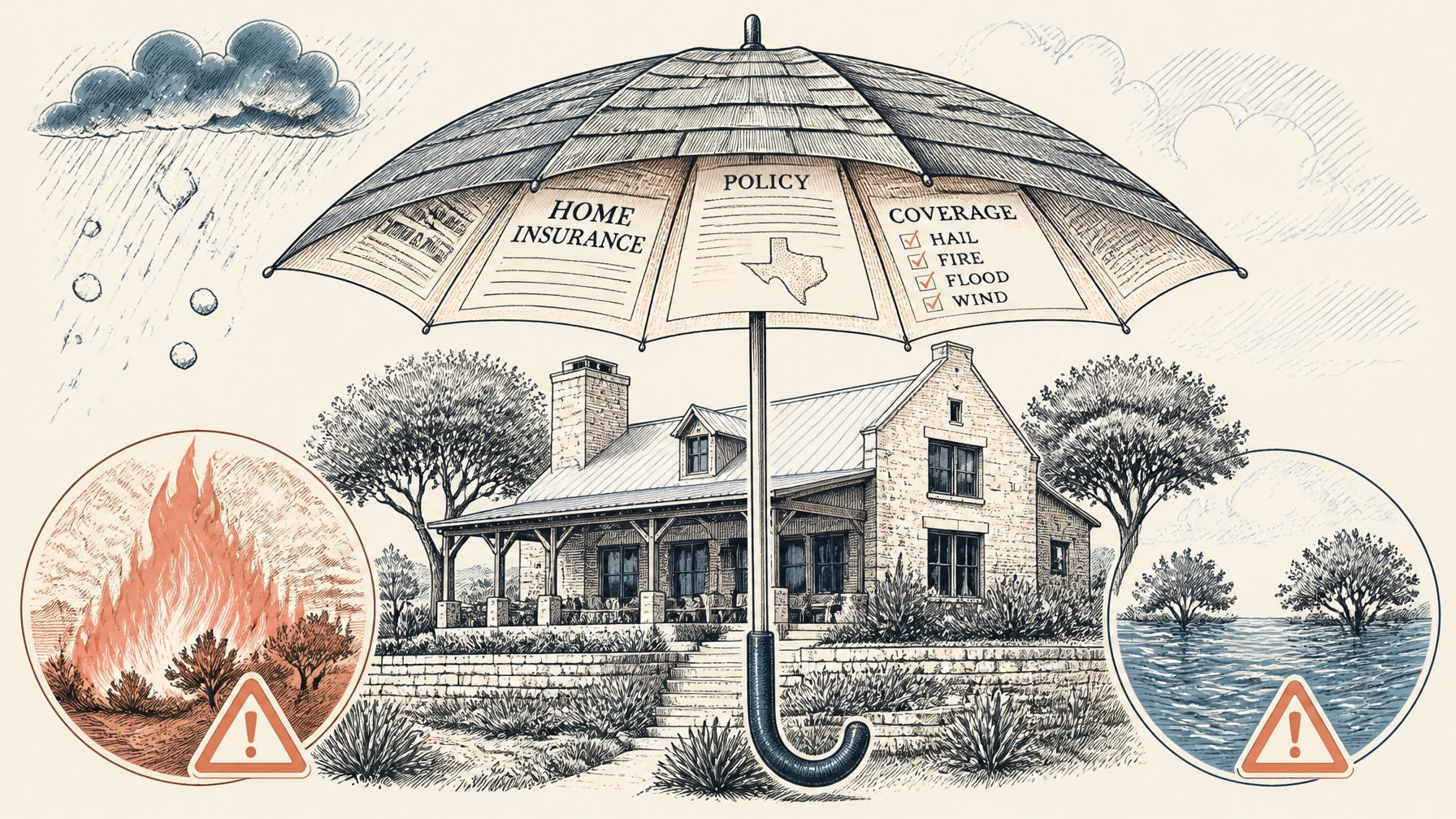
A Texas Hill Country home can offer the retirement lifestyle many people imagine: limestone walls, long views, quiet roads, outdoor living, and enough room for visiting family. But the same landscape that makes the region beautiful can also create insurance questions that do not always arise in a suburban neighborhood.
How close is the property to a fire station? Is the home near a creek or low-water crossing? What kind of roof can withstand Central Texas hail? Does a standard homeowners policy cover wildfire damage? What happens if a storm makes the home unlivable?
These questions are worth asking before you buy, build, or relocate. Insurance is not simply a line item to compare after you fall in love with a property. It can affect your ongoing retirement expenses, your cash reserves, and the practical enjoyment of your home.
The Texas Department of Insurance offers a helpful starting point: “Most home policies don’t cover floods. But floods can happen anywhere.” Read the Texas Department of Insurance home insurance guide for a detailed explanation of coverage, deductibles, claims, and exclusions.
What standard homeowners insurance usually covers
A typical Texas homeowners policy combines several types of protection. Exact terms vary by insurer and policy, so your declarations page and policy documents matter.
Common coverage may include:
- Dwelling coverage: Helps repair or rebuild the main home after damage from a covered event.
- Personal property coverage: Helps replace furniture, clothing, appliances, and other belongings.
- Other structures coverage: May apply to detached garages, sheds, fences, and similar structures.
- Additional living expenses: May help pay for temporary housing, food, and related costs if a covered loss makes the home uninhabitable.
- Personal liability coverage: Helps protect you if you are legally responsible for an injury or property damage.
- Medical payments coverage: May cover certain medical expenses for guests injured on your property.
Most Texas home policies generally cover fire, lightning, windstorm, and hail. However, coverage varies, and some policies may include special deductibles, exclusions, or limitations.
That is especially important in the Hill Country, where properties can range from in-town homes in Boerne or New Braunfels to large, wooded acreage outside Wimberley, Fredericksburg, or Dripping Springs.

Wildfire coverage—Look beyond the word “fire”
Wildfire damage is typically treated as fire or smoke damage under a standard homeowners policy. If a wildfire damages the home, attached structures, or personal property, the policy may respond up to its coverage limits and subject to the deductible.
That does not mean every wildfire-related expense is automatically covered. Important details may include:
- Whether the dwelling limit is high enough to rebuild the home at current construction prices
- Whether detached structures such as guest houses, barns, workshops, or pool houses are adequately insured
- Whether landscaping, trees, fencing, and outdoor improvements are covered or limited
- Whether additional living expenses are available if the home cannot be occupied
- Whether the policy has specific exclusions or conditions for rural properties
A rural or heavily wooded setting may also affect whether an insurer is willing to write the policy and how much it charges. The distance to a responding fire station, the availability of fire hydrants, the condition of access roads, nearby brush, and the property’s construction materials may all be part of underwriting.
Ask whether the insurer offers credits for measures such as defensible space, fire-resistant roofing, cleared brush, monitored alarms, or other improvements. A premium discount should not be the only reason to make a safety upgrade, but it may help offset some of the cost.
Hail and wind—The roof deserves special attention
Hail can damage shingles, gutters, skylights, siding, windows, and outdoor equipment in a matter of minutes. Central Texas homeowners should understand not just whether hail is covered, but how the policy handles roof damage.
Ask these questions:
- Is the roof covered for replacement cost or actual cash value?
- Is there a separate wind or hail deductible?
- Is the deductible a flat dollar amount or a percentage of dwelling coverage?
- Are older roofs subject to special limitations?
- Does the policy require certain roofing materials or maintenance standards?
- Are impact-resistant shingles eligible for a discount?
- Are detached structures covered under the same deductible?
The difference between replacement cost and actual cash value can be significant. Replacement cost generally considers what it costs to repair or replace the damaged property today, subject to the policy terms. Actual cash value subtracts depreciation for age and wear.
For example, an older roof may have a much lower actual cash value than the price of installing a new roof. The Texas Department of Insurance explains the difference in its guide to replacement cost and actual cash value coverage.
Do not assume that a low annual premium is the better choice. A policy with a lower premium but a large percentage-based hail deductible could require a substantial out-of-pocket payment after a storm.

Flood coverage is usually separate
One of the most important distinctions for Hill Country homeowners is the difference between water damage and flooding.
A standard homeowners policy may cover sudden and accidental water damage, such as a burst pipe. It typically does not cover flood damage caused by rising water from heavy rain, a creek, river, drainage channel, or flash flood.
Flood risk is not limited to coastal communities. Low-water crossings, steep terrain, rocky soil, and fast-moving runoff can create localized risks throughout the Hill Country. A property outside a high-risk FEMA flood zone may still experience flooding.
The Texas Department of Insurance recommends discussing flood coverage with an agent or exploring a policy through the National Flood Insurance Program. Private flood policies may also be available, depending on the property and insurer.
Two details deserve special attention:
- Many flood policies have a waiting period before coverage begins.
- Flood insurance may not provide the same additional-living-expense benefits as a homeowners policy.
That means flood coverage is not something to arrange after a storm is in the forecast. If you are buying a home, ask about the available policy and effective date early in the process.

How property location can affect your premium
Two homes in the same county can have very different insurance costs. Location-based factors may include:
- Distance from a fire station or hydrant
- Emergency vehicle access and road conditions
- Proximity to brush, wooded areas, creeks, or flood-prone terrain
- Local hail and severe-weather history
- Crime and claims patterns in the area
- Whether the home is within city limits or in a rural area
- Availability of contractors and building materials
- The home’s age, condition, size, and replacement cost
- Roof type, age, and construction materials
- Your personal claims history and, with some insurers, credit-based insurance factors
A stone or masonry home may be viewed differently from a home built primarily with wood materials. However, stone construction does not eliminate every risk. Roofs, windows, decks, fencing, landscaping, septic systems, wells, and detached structures still need to be evaluated.
The property’s replacement cost may also be higher than its purchase price. Custom finishes, imported materials, long construction distances, difficult terrain, and specialized labor can all affect what it would cost to rebuild.
The Texas Department of Insurance explains that insurers may consider a home’s age, condition, construction materials, replacement cost, location, fire protection, and claims history when setting premiums. Its consumer home insurance guide is a useful resource when comparing quotes.
Questions to ask before choosing a policy
Before closing on a Hill Country property, ask the insurance agent:
- What exactly is covered for wildfire, smoke, hail, and wind?
- Is flood coverage included, or would I need a separate policy?
- What are my flat and percentage-based deductibles in dollar terms?
- Is my roof insured at replacement cost or actual cash value?
- Are guest houses, barns, workshops, fences, wells, or septic systems covered?
- Are there limits on landscaping, trees, jewelry, artwork, or outdoor equipment?
- How much additional-living-expense coverage is available, and for how long?
- Are there exclusions related to vacancy, short-term rentals, or extended travel?
- Could brush clearing, roof upgrades, alarms, or fire-resistant materials reduce the premium?
- How has the insurer handled recent hail, wildfire, and flood claims in this area?
- Is the policy renewable, and what conditions could lead to nonrenewal?
- What documentation should I keep before a loss?
Create a home inventory before moving in. Photograph rooms, storage areas, outbuildings, tools, artwork, electronics, and other valuable possessions. Keep receipts and documentation in a secure location away from the property. The Texas Department of Insurance provides a home inventory checklist to help organize the process.

Make insurance part of the retirement home decision
Insurance belongs in the same conversation as maintenance, utilities, travel distance, and property taxes when you evaluate a Hill Country retirement home. The right property may still be worth the cost, but the cost should be understood before you commit.
As we discussed in The Hidden Cost of Hill Country Living We Never Expected, rural and acreage living can bring irregular expenses that do not appear in a standard monthly budget. Insurance premiums, deductibles, roof repairs, wildfire mitigation, and flood protection are part of that broader picture.
A thoughtful retirement plan should account for both predictable premiums and occasional large out-of-pocket costs. Keeping adequate liquidity and coordinating major home decisions with your broader financial plan can help you enjoy the landscape without allowing an unexpected loss to disrupt your lifestyle.
Insurance is personal, and policy language matters. Compare coverage—not just premiums—and ask questions until you understand what would happen after the specific disasters most likely to affect your property.
Schedule a private meeting with a fiduciary financial advisor today by calling (512) 593-8380 or by visiting: https://calendly.com/portafoliocapital/15min
Portafolio Capital Management dba Mau Sanchez Capital is a Registered Investment Adviser. This content is for informational purposes only and does not constitute investment advice or a solicitation to buy or sell any security. Advisory services are provided only pursuant to a written advisory agreement.
This article may include stories, scenarios, and perspectives created or assisted by artificial intelligence. Although the individuals and circumstances described may be fictional, the topics are intended to reflect real financial, personal, and lifestyle issues that retirees and individuals commonly face. The content is provided to encourage readers to consider different perspectives that may affect their retirement, regardless of whether they are currently planning, approaching retirement, or already retired. It is intended for general educational and informational purposes only and should not be interpreted as personalized investment, financial, tax, legal, medical, or retirement-planning advice. Individual circumstances vary. Readers should independently verify any information presented and consult appropriately qualified professionals before making financial or personal decisions. No advisory, professional, or client relationship is created through the use of this website.
Leave a Reply