
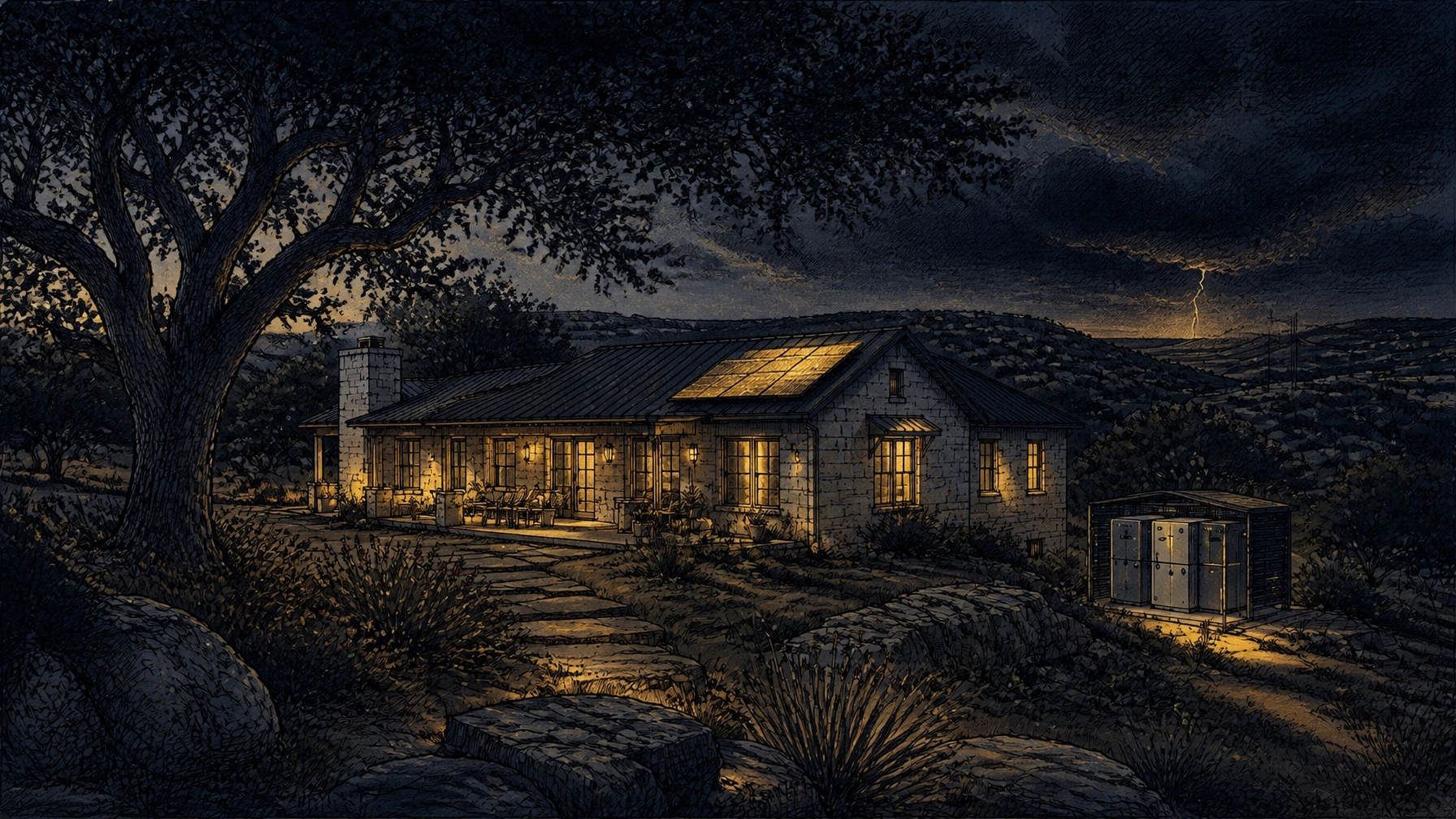
The appeal of an off-grid Hill Country home is easy to understand. You wake up to limestone ridges, live oak canopies, and wide-open skies. Your morning coffee may come from a propane range, your water from a private well, and your electricity from the sun overhead.
For retirees and pre-retirees, however, energy independence is about more than installing solar panels. It is a lifestyle decision involving comfort, maintenance, backup planning, and long-term costs.
The most practical setup for many Hill Country homeowners is not a completely off-grid system. It is a hybrid arrangement—solar panels and batteries connected to the utility grid, with a generator or other backup option for extended outages. That combination can offer meaningful resilience without requiring you to manage every watt of electricity yourself.
What the 2021 freeze taught Texas homeowners
The February 2021 winter storm exposed how vulnerable a large regional power system can become under extreme conditions. According to the Federal Energy Regulatory Commission and the North American Electric Reliability Corporation, more than 4.5 million Texans lost power, some for as long as four days.
The agencies described the event as the “largest manually controlled load-shedding event in U.S. history.”
The University of Texas Energy Institute also described Winter Storm Uri as a massive failure of electricity generation. Freezing conditions affected power plants, fuel supplies, natural gas infrastructure, and other parts of the system.
The lesson for a rural homeowner is not that the Texas grid will always fail. It is that a beautiful property outside Boerne, Fredericksburg, Wimberley, Dripping Springs, or Kerrville may need more infrastructure planning than a home inside a city neighborhood.
A grid-connected solar system by itself is not a complete outage solution. Most standard grid-tied systems automatically shut down when utility power goes out. This protects utility workers from electricity being fed back onto lines they believe are de-energized.
To keep your home running during an outage, you generally need:
- Solar panels
- A battery storage system
- An inverter capable of safely disconnecting and “islanding” the home
- A backed-up electrical panel or whole-home transfer system
- A plan for extended cloudy periods
- A backup generator if you want additional resilience
The three energy choices for a Hill Country home
1. Grid-tied solar without batteries
This is the simplest solar arrangement. Your panels produce electricity during the day, reducing the amount you purchase from the utility. Depending on your utility provider and electricity plan, excess generation may receive a credit or other treatment.
The advantage is a lower upfront cost and relatively simple operation. The limitation is important—when the grid fails, your solar system will usually shut down as well.
This approach may be appropriate for someone primarily focused on reducing electricity purchases. It is less suitable for a retiree whose priority is maintaining power during an outage.
2. Hybrid solar with battery backup
A hybrid system keeps your home connected to the grid while adding batteries and backup controls. During normal conditions, solar energy can help serve the home and charge the batteries. During an outage, selected circuits, or the entire home, depending on the design, can continue operating.
For many Hill Country homeowners, this is the practical middle ground.
A hybrid system can support important household functions such as:
- Refrigeration and cooking
- Lighting and communications
- Internet equipment
- Medical devices
- Security systems and electric gates
- Well pumps
- Selected heating and cooling equipment
The key is to have the system designed around your actual household loads. A battery that can keep a refrigerator and a few lights running may not be able to operate central air conditioning, a well pump, an electric range, and a swimming-pool pump at the same time.
3. True off-grid living
A fully off-grid home has no dependable utility connection. Every watt must be generated, stored, or supplied by an alternative fuel source.
This can make sense for a remote property where extending utility service would be extremely expensive. It can also appeal to homeowners who place a high value on independence and are comfortable with more active system management.
But true off-grid living requires planning for the least favorable conditions, not just a sunny spring day. Your system must account for hot summer afternoons, cold snaps, cloudy weather, battery replacement, generator fuel, and unexpected equipment failures.
For a low-maintenance retirement lifestyle, complete independence may create more responsibility than expected.

Why Texas cooling changes everything
In much of the country, heating is the dominant household energy concern. In the Hill Country, air conditioning can be the more difficult design challenge.
A conventional central air-conditioning system may draw significant power when the compressor starts. On a hot afternoon, cooling can consume a large share of the energy produced by your solar array. If the batteries are already depleted, the system may need to reduce cooling or start a generator.
This is why energy planning should begin with a professional load analysis rather than a panel count. A designer should evaluate:
- The size and efficiency of your HVAC system
- Compressor startup requirements
- Insulation and window performance
- Well-pump demand
- Electric water heating
- Kitchen appliances
- Pool equipment
- Workshop or garage loads
- Medical and accessibility equipment
Variable-speed HVAC systems, efficient appliances, shaded windows, and high-quality insulation can make a meaningful difference. In retirement, comfort matters, but so does avoiding a system that is oversized, expensive, and difficult to maintain.
What solar and batteries may cost
Exact pricing varies by home size, roof design, equipment, electrical upgrades, permitting, site access, and labor. Rural acreage can add costs because of longer cable runs, detached structures, difficult terrain, or the need for ground-mounted panels.
As a broad 2026 reference point, EnergySage reports a typical Texas battery cost of approximately $1,059 per kilowatt-hour installed, with a 13.5-kilowatt-hour system costing roughly $14,000 before considering the details of a particular project.
That does not mean every project will fall within that range. A single battery may support essential circuits for a limited period, while a whole-home system with multiple batteries can cost substantially more.
Illustrative planning ranges might look like this:
| Goal | Possible configuration | Illustrative installed range |
|---|---|---|
| Essential outage backup | Solar with one battery and a critical-loads panel | $15,000–$30,000 or more |
| Stronger household resilience | Larger solar array with multiple batteries | $30,000–$70,000 or more |
| Comfortable, mostly off-grid living | Larger array, substantial storage, generator, and efficient HVAC | $80,000–$150,000 or more |
These are planning estimates, not quotes. A detailed proposal should show equipment, labor, electrical work, permits, monitoring, warranties, and expected maintenance separately.
It is also important to budget for replacement cycles. Panels may continue producing electricity for decades, but inverters, batteries, generators, and well equipment will eventually require service or replacement.
The rural infrastructure connection
Power does not operate in isolation on a Hill Country property. If your home uses a private well, the pump needs electricity. If you have septic equipment, gates, security systems, a workshop, or a detached guest casita, those may also be part of your energy plan.
This is one reason a solar conversation should happen alongside a broader property review. The Hill Country Retirement Guide discussion of unexpected rural living costs covers the less visible expenses associated with wells, septic systems, propane, long drives, maintenance, insurance, and acreage.
An off-grid home may eliminate a monthly utility bill, but it does not eliminate household expenses. It shifts them toward equipment, fuel, inspections, repairs, and capital reserves.
Questions to ask before buying or building
If you are considering a home with solar or battery storage, ask for documentation rather than relying on a listing description.
Important questions include:
- What is the solar array’s age, size, and recent production history?
- What brand, model, and chemistry are the batteries?
- How much usable storage remains?
- Is the system designed for essential loads or whole-home backup?
- Can it operate the HVAC, well pump, and internet equipment?
- Is there a generator, and does it start automatically?
- What warranties remain on the panels, batteries, and inverter?
- Who services the equipment locally?
- What are the annual maintenance and monitoring costs?
- Is the home connected to the utility grid?
- What happens during several cloudy days?
- Are the batteries housed in a protected, temperature-controlled location?
A home inspection should include more than the roof and foundation. Ask qualified professionals to review the electrical system, battery installation, generator, well, septic system, propane setup, and communications infrastructure.

The retirement lifestyle tradeoff
The right system depends on what you want retirement to feel like.
If your ideal morning includes quiet coffee on a porch and you are comfortable monitoring batteries, shifting heavy electricity use to sunny hours, and maintaining backup equipment, a fully off-grid home may be rewarding.
If you want the scenery and privacy of acreage without frequently thinking about energy reserves, a grid-connected hybrid system may be more practical. It can provide backup for important household functions while allowing the utility to serve as a safety net during extended storms or unusually high demand.
Neither choice is automatically better. The important question is whether the system matches your comfort expectations, health needs, property design, and available cash flow.
Energy independence is also a financial decision. The upfront cost may compete with other uses for retirement assets, while future batteries, inverters, roofs, generators, wells, and property improvements need to be included in your long-term planning.

A practical path forward
Before purchasing land or signing a construction contract, define your priorities:
- Decide whether you want outage protection, reduced utility use, or true energy independence.
- Review the property’s utility access and rural infrastructure.
- Have the home’s electricity demand measured or professionally estimated.
- Compare a hybrid design with a fully off-grid design.
- Request at least two detailed proposals.
- Create a reserve for equipment maintenance and replacement.
- Coordinate the project with your broader retirement income plan.
For many retirees, the most comfortable solution is not a dramatic escape from the grid. It is a thoughtfully designed home that uses solar power, stores energy for interruptions, and retains practical backup options when the weather does not cooperate.
That approach can preserve what makes the Texas Hill Country so appealing—quiet mornings, open space, and a slower pace—without turning every cloudy week into a household emergency.
Schedule a private meeting with a fiduciary financial advisor today by calling (512) 593-8380 or by visiting: https://calendly.com/portafoliocapital/15min
Portafolio Capital Management dba Mau Sanchez Capital is a Registered Investment Adviser. This content is for informational purposes only and does not constitute investment advice or a solicitation to buy or sell any security. Advisory services are provided only pursuant to a written advisory agreement.
This article may include stories, scenarios, and perspectives created or assisted by artificial intelligence. Although the individuals and circumstances described may be fictional, the topics are intended to reflect real financial, personal, and lifestyle issues that retirees and individuals commonly face. The content is provided to encourage readers to consider different perspectives that may affect their retirement, regardless of whether they are currently planning, approaching retirement, or already retired. It is intended for general educational and informational purposes only and should not be interpreted as personalized investment, financial, tax, legal, medical, or retirement-planning advice. Individual circumstances vary. Readers should independently verify any information presented and consult appropriately qualified professionals before making financial or personal decisions. No advisory, professional, or client relationship is created through the use of this website.
Leave a Reply