
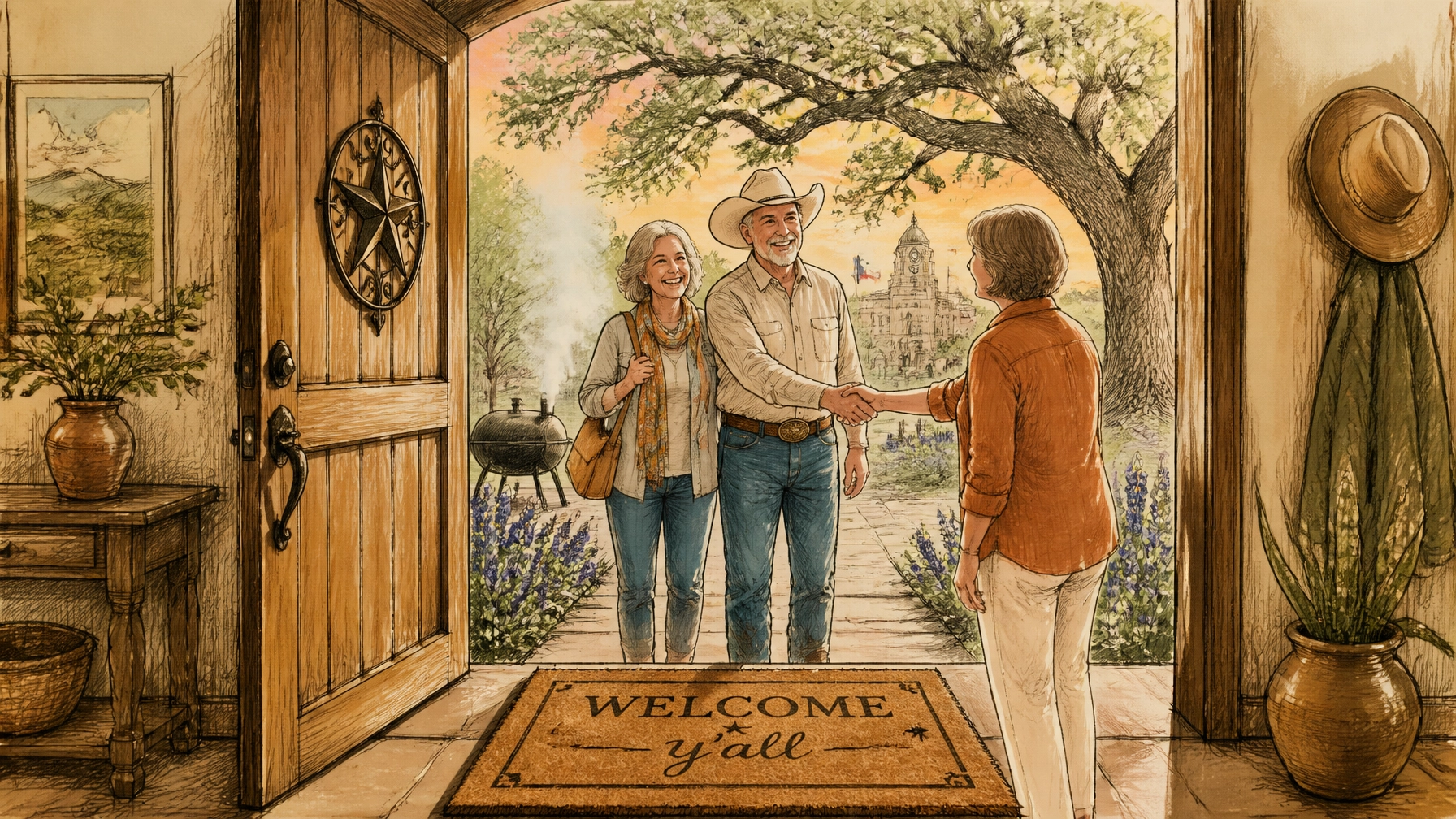
Moving to the Texas Hill Country can feel like stepping into a slower, warmer version of life. There are limestone buildings, live oak trees, porch conversations, farmers markets, local music, and neighbors who may wave as you pass.
Many out-of-state retirees arrive expecting Texas hospitality to be genuine. In most cases, it is. But they may not expect how that hospitality works.
The first welcome can be immediate. The deeper sense of belonging often takes longer.
That difference is what we might call the Texas hospitality gap—the space between being treated warmly and becoming part of the community.
For retirees considering Boerne, Wimberley, Fredericksburg, Dripping Springs, or New Braunfels, understanding that distinction can make the transition easier—and more rewarding.
Texans May Be Friendly Before They Become Familiar
One of the first cultural adjustments for newcomers is the amount of everyday friendliness.
A cashier may ask how your morning is going. A stranger may hold the door open. Someone walking past your home may wave from the road. At a local shop, a short transaction can turn into a conversation about the weather, the upcoming festival, or whether the bluebonnets are blooming yet.
For retirees moving from a more reserved region, this can feel unusually personal. For those coming from a major city, it may seem almost theatrical at first.
Usually, it is neither. It is simply part of the social rhythm.
The important distinction is that friendliness does not always mean instant friendship. Longtime residents may already have family connections, school relationships, church communities, volunteer commitments, and decades of shared history. They can be welcoming while still maintaining established circles.
That does not mean newcomers are excluded. It means belonging is generally built through repeated contact.
You may have several pleasant conversations with the same person before either of you suggests coffee. You may attend an event where everyone is kind, yet still feel like an observer. That is normal during the early months.
In a recent first-person account about moving to Dripping Springs, one retiree described the need to make a deliberate effort to build a social life rather than waiting for one to appear. You can read more about that adjustment in “I Retired at 62 and Moved to Dripping Springs: Here’s What Nobody Told Me About the First 6 Months”.
Church Culture Is Often Part of the Community Infrastructure
Out-of-state retirees are sometimes surprised by the visibility of churches in small-town Texas life.
Texas is religiously diverse, but Christianity remains the largest religious identity among Texas adults, according to the Pew Research Center’s Texas religious landscape profile. In many Hill Country communities, churches are not only places of worship. They may also serve as gathering points for food drives, volunteer projects, support networks, musical programs, holiday events, and community assistance.
That can be an adjustment for retirees who are secular, belong to a different faith, or prefer to keep religion private.
The lesson is not that you need to join a church to build a life in the Hill Country. You do not. Rather, it helps to recognize that some social connections may flow through religious institutions even when the activity itself is broadly community-oriented.
If church participation is not right for you, look for other consistent points of connection:
- Local historical societies
- Libraries and lifelong-learning programs
- Arts organizations and gallery events
- Walking, cycling, golf, or pickleball groups
- Volunteer opportunities
- Civic associations
- Community gardens
- Farmers markets and regular town events
The goal is to find places where people see you more than once. One-time attendance is a start. Consistent participation is what turns familiarity into connection.

Manners Can Be More Formal Than You Expect
Texas conversation often combines informality with respect.
You may hear “sir,” “ma’am,” and “y’all” in the same exchange. A person may speak casually while still using formal terms of address. Someone may disagree with you but take care to do it politely. Holding a door, greeting people when entering a room, and acknowledging employees in a store may be considered basic courtesy.
These habits vary by age, location, and personality. Austin, San Antonio, and other larger urban areas may feel different from a small Hill Country town. Still, retirees moving from the Northeast, West Coast, or Midwest often notice the emphasis on greetings and small talk.
Small talk is not always a demand for personal information. It is often a social handshake.
A few simple habits can help:
- Return a greeting instead of walking past silently.
- Give yourself a little extra time for errands.
- Ask local residents for recommendations.
- Learn the difference between a friendly question and an intrusive one.
- Do not mistake a slower conversation for inefficiency.
- Remember that “How are you?” may be an invitation to connect, not a formal question requiring a detailed answer.
As one observation from a recent Hill Country relocation story put it, slowing down is not necessarily a lack of productivity. It can be a decision to give people more attention.
That change in pace may be one of the most meaningful parts of a peaceful Texas Hill Country retirement.
Food Is an Invitation, Not Just a Preference
Newcomers often arrive with a list of restaurants to try. They may not realize how often food functions as a local language.
Barbecue, Tex-Mex, German-influenced dishes, homemade desserts, breakfast tacos, kolaches, iced tea, and local wine are not simply menu items. They are often tied to family traditions, fundraisers, festivals, holidays, and regional identity.
A plate of brisket at a community gathering may be part of a benefit for a local organization. A festival meal may reflect a town’s heritage. A winery visit may become a recurring social tradition rather than a one-time tourist outing.
The Texas Hill Country Trail Region events calendar and Texas Highways Hill Country events listings offer useful ways to explore fairs, markets, food events, music, and heritage celebrations throughout the region.
Food culture can also expose practical differences. In a smaller town, you may not find every national restaurant or specialty grocery store nearby. Certain dietary preferences may require more planning. On the other hand, local producers, farm stands, independent restaurants, and regional markets can provide a more personal experience than many retirees are used to.
The best approach is to arrive curious. Ask what a dish is, where locals go, and which event is worth attending. People are often proud to share their recommendations.

Community Participation Matters More Than You May Expect
In some places, retirement can be private and anonymous. You move into a neighborhood, maintain your home, and interact mostly with a small circle of friends.
The Hill Country can accommodate that lifestyle, particularly in a gated community or a low-maintenance neighborhood. But in many towns, residents place real value on showing up.
That may mean attending a local market, supporting a charity event, visiting a small business, joining a civic group, or becoming a regular at a community gathering. You do not have to attend everything. You do have to participate enough for people to recognize you.
The region’s event culture often reflects this expectation. Wimberley Market Days, local art walks, county fairs, seasonal festivals, rodeos, and music events create opportunities for repeated interaction.
This is especially important for retirees who have left behind careers, extended family, and established friendships. A beautiful home does not automatically create a fulfilling retirement. A calendar with a few meaningful commitments often does more for daily satisfaction than another home upgrade.
In another Hill Country relocation story, a couple found that their community became real only after they began volunteering and joining local groups. Their experience reflects a broader truth—the landscape may attract you, but participation helps you stay connected.
Privacy and Neighborliness Can Coexist
Some newcomers expect Texas neighbors to be constantly involved in one another’s lives. Others expect small-town residents to be distant or overly watchful.
The reality is usually more balanced.
A neighbor may help you find a contractor, check on your home after a storm, or point you toward a local physician. That same neighbor may not drop by without notice or expect a standing invitation every weekend.
Many Hill Country communities value both generosity and personal boundaries. You can have a strong sense of neighborliness without giving up your privacy.
This is worth considering when choosing a retirement setting. Rural acreage, a historic downtown neighborhood, and a master-planned community can each offer a different level of visibility and social interaction.
Before choosing a home, spend time in the area at different times of day and during different seasons. Visit on a quiet weekday and during a major event. Eat at a local restaurant, shop for groceries, and notice how people interact. You are not just evaluating a property. You are learning whether the community’s pace and expectations suit you.

How to Close the Hospitality Gap
You do not need to become a different person to fit into the Texas Hill Country. You may simply need to become more intentional.
Start with these steps:
- Choose a regular place. Visit the same coffee shop, market, trail, or restaurant often enough to become familiar.
- Accept a few invitations. Even if an event is outside your usual routine, it may help you understand the community.
- Ask questions. Locals can explain traditions, routes, restaurants, and seasonal events better than a relocation brochure.
- Join before you feel ready. A club or volunteer group may feel awkward the first time. Give it several visits.
- Respect local traditions without pretending. You can appreciate church events, barbecue culture, ranch traditions, or Texas pride without adopting every custom.
- Be patient. A meaningful social life is usually built over months, not a single welcome reception.
The Texas hospitality gap is not a contradiction. It is the difference between a culture that is quick to welcome and a community that takes time to know you.
For retirees, that can be good news. You do not have to arrive with a fully formed social circle. You only need the willingness to return, participate, and let relationships develop at their own pace.
The Hill Country may greet you on day one. It may feel like home after a season of showing up.
Schedule a private meeting with a fiduciary financial advisor today by calling (512) 593-8380 or by visiting: https://calendly.com/portafoliocapital/15min
Portafolio Capital Management dba Mau Sanchez Capital is a Registered Investment Adviser. This content is for informational purposes only and does not constitute investment advice or a solicitation to buy or sell any security. Advisory services are provided only pursuant to a written advisory agreement.
This article may include stories, scenarios, and perspectives created or assisted by artificial intelligence. Although the individuals and circumstances described may be fictional, the topics are intended to reflect real financial, personal, and lifestyle issues that retirees and individuals commonly face. The content is provided to encourage readers to consider different perspectives that may affect their retirement, regardless of whether they are currently planning, approaching retirement, or already retired. It is intended for general educational and informational purposes only and should not be interpreted as personalized investment, financial, tax, legal, medical, or retirement-planning advice. Individual circumstances vary. Readers should independently verify any information presented and consult appropriately qualified professionals before making financial or personal decisions. No advisory, professional, or client relationship is created through the use of this website.
Leave a Reply