
For many people considering retirement in Boerne, Wimberley, Dripping Springs, Fredericksburg, or the surrounding Hill Country, water is part of the lifestyle conversation.
A property may offer limestone views, live oaks, outdoor entertaining areas, and room for a garden. But it may also rely on a private well, a septic system, or a water provider serving a fast-growing community. Rainfall can arrive in dramatic bursts, followed by long, hot stretches when lawns and gardens need the most attention.
Rainwater harvesting does not eliminate every water challenge. It is not a guarantee against drought, and it should not be viewed as a substitute for thoughtful property research. But when planned properly, it can become something more than a utility feature. A cistern, rain garden, or carefully designed collection system can become part of the architecture and landscape—a practical feature that also adds character to a Hill Country home.
As the Hill Country Alliance explains, “Water is scarce in the Texas Hill Country.” That reality does not need to create fear. It simply calls for more intentional design.
Why rainwater harvesting fits the Hill Country
The Texas Hill Country has a distinctive water pattern. Rain may be limited for weeks and then arrive in a powerful storm. That makes it difficult to rely only on rainfall at the exact moment it occurs. Collection and storage allow homeowners to make better use of the water that does fall on the roof.
Rainwater harvesting may support
- Native and drought-tolerant landscaping
- Raised vegetable and herb gardens
- Trees and ornamental plants
- Drip irrigation
- Small lawns or courtyards
- Outdoor cleaning and similar non-potable uses
The Texas Water Development Board notes that a well-designed system can collect approximately 1,000 gallons for every inch of rainfall that falls on a 2,000-square-foot roof, assuming roughly 80% collection efficiency.
The exact amount depends on roof area, roof material, gutters, filtration, storage capacity, rainfall intensity, and losses from overflow or evaporation. Still, the basic idea is compelling—the roof already exists, the rain already falls, and the system captures a resource that might otherwise run across driveways and into drainage channels.
How a residential system works
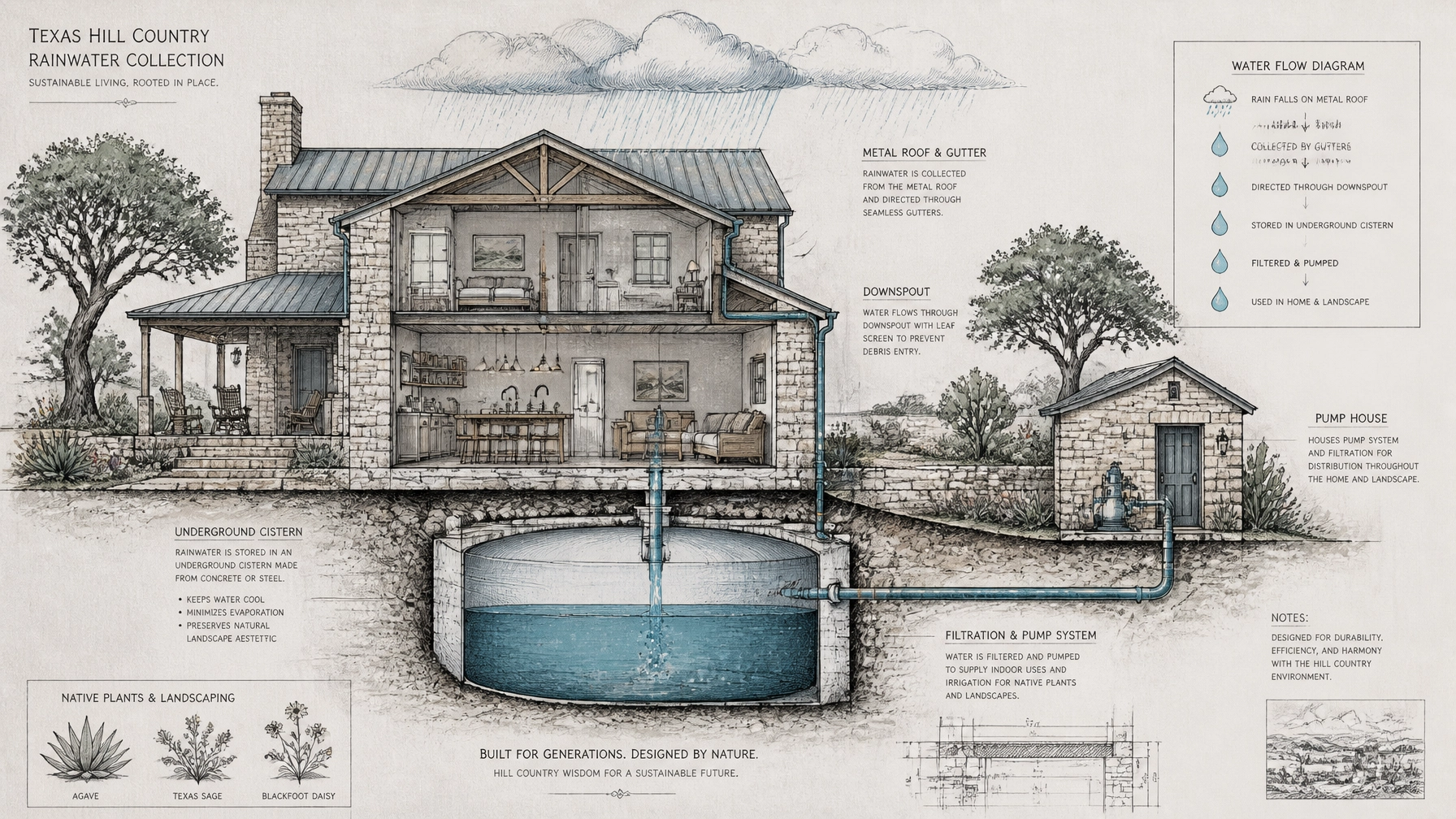
A rainwater harvesting system can be as simple as a rain barrel below one downspout or as sophisticated as a whole-home system with multiple cisterns, pumps, filtration, and treatment.
Most residential systems include several basic elements.
1. The catchment surface
The roof is the primary collection surface. Smooth metal roofing is commonly viewed as an efficient choice for rainwater collection, while other roofing materials may be more appropriate for irrigation than drinking-water applications.
Roof condition also matters. Dust, leaves, pollen, animal activity, and debris can affect water quality. Tree placement should be considered during both home design and system installation.
2. Gutters and downspouts
Gutters direct water from the roof toward the storage tank. In the Hill Country, intense storms can overwhelm undersized gutters or downspouts, particularly where roof valleys concentrate runoff.
A qualified installer can evaluate the roof footprint, slope, gutter capacity, and number of downspouts before recommending a system.
3. Leaf screens and first-flush diverters
Leaf screens keep larger debris out of the system. A first-flush diverter sends the initial runoff away from the cistern. This first flow may carry accumulated dust, pollen, bird waste, and other material from the roof.
The Texas Manual on Rainwater Harvesting describes the first-flush component as an important way to improve the quality of water entering the tank.
4. Storage cisterns
The cistern is the visual centerpiece of many systems. Storage may be provided by one large tank or several smaller tanks connected together.
The appropriate size depends on
- Roof area
- Expected rainfall
- Intended use
- Outdoor water demand
- Length of dry periods
- Available space
- Budget
- Desired level of independence
As the TWDB manual puts it, “The basic rule for sizing any rainwater harvesting system is that the volume of water that can be captured and stored must equal or exceed the volume of water used.”
That is why a large tank alone is not always the answer. If the landscape requires more water than the roof can collect, additional storage will not solve the imbalance. Water-wise planting and efficient irrigation are just as important as tank capacity.
5. Pumps and delivery lines
Gravity can serve some gardens, especially when the tank is elevated. Many residential systems use a pump to move water to drip irrigation lines, outdoor fixtures, or other end uses.
If the system is connected to indoor plumbing, additional design and safety requirements apply.

Choosing between non-potable and potable use
For many retirees, the most practical starting point is non-potable use. This means collecting rainwater for landscaping, gardens, livestock, or other outdoor purposes rather than drinking or bathing.
A non-potable system can be simpler and easier to maintain, particularly when it is separate from the home’s indoor plumbing.
Potable use is more complicated. Rainwater can pick up contaminants from the atmosphere, roof, gutters, storage tank, and plumbing. It must be appropriately filtered, disinfected, tested, and maintained before being used for drinking.
The TWDB states that homeowners should contact local officials regarding testing and construction requirements for potable systems. If a rainwater system is connected to a public water supply and used for potable indoor purposes, Texas law requires cross-connection safeguards. Consent from the municipality or public water supplier may also be required, and installation and maintenance may need to be performed by appropriately licensed plumbing professionals.
The takeaway is simple—decide how you intend to use the water before choosing equipment. Outdoor irrigation and drinking water are not the same project.
Do you need a permit in Texas?
Texas generally does not require a statewide permit for a residential rainwater harvesting system. However, that does not mean every installation is free from local requirements.
Before purchasing a tank, check with the relevant city or county office about
- Building and plumbing permits
- Electrical requirements for pumps
- Setbacks from property lines
- Well and septic separation
- Drainage and overflow
- Floodplain restrictions
- Tank placement and screening
- Requirements for connections to public water
The rules may differ between an unincorporated area and a city such as Boerne, San Antonio, or Wimberley.
Texas law also prevents homeowners’ associations from adopting new covenants that ban rainwater harvesting systems. However, an HOA may still establish reasonable aesthetic rules concerning placement, visibility, screening, or tank color. Review the community’s deed restrictions before beginning the project.
Making the cistern part of the design
A cistern does not have to look like an afterthought.
In a luxury Hill Country home, the storage tank can be integrated into the landscape in several ways
- Use a wood tank that complements a ranch-style or farmhouse design.
- Select a galvanized metal tank as an architectural accent.
- Screen the tank with native grasses, shrubs, or a low stone wall.
- Place the cistern near a barn, garden house, or detached garage.
- Build a stone-faced enclosure that echoes the home’s limestone.
- Use an underground tank where site conditions and budget make sense.
- Connect an overflow outlet to a rain garden or planted swale.
The goal is not to hide every sustainable feature. It is to make the feature feel intentional.
A thoughtfully designed cistern can reinforce the visual language of the property, much like a pergola, water feature, or outdoor fireplace. Historic Hill Country properties often used stone cisterns, elevated tanks, and practical water structures. Modern systems can draw from that tradition without appearing dated.

Pair the system with a water-wise landscape
Rainwater harvesting works best when paired with a landscape that respects the local climate.
Native and adapted plants generally require less supplemental irrigation once established. Grouping plants according to water needs can make irrigation more efficient. Mulch helps slow evaporation, while drip irrigation directs water closer to plant roots.
Large expanses of turf can be attractive, but they may require more water than a residential roof can reliably provide during a hot, dry summer. A landscape built around native grasses, shade trees, pollinator plants, stone paths, raised beds, and small lawn areas may be easier to maintain and more compatible with a retirement lifestyle.
For homeowners who enjoy gardening, a rainwater system can also make outdoor routines more rewarding. The system becomes part of the rhythm of the property—inspecting the gutters before storm season, watching the tank level rise after a rain, and using stored water during the drier weeks.
What should a homeowner budget for?
Costs vary widely. The storage tank is often the largest expense, but gutters, downspouts, filtration, pumps, electrical work, excavation, landscaping, and professional installation can all affect the total.
The TWDB’s FAQ gives a historical general estimate of $8,000 to $10,000 for a typical single-family system, while noting that costs rise for larger systems, professional installation, or potable use. Because prices and local conditions change, homeowners should obtain current estimates for their specific property.
It is also wise to account for ongoing maintenance. Gutters and screens need cleaning. First-flush diverters must remain functional. Pumps and filters may eventually need service or replacement. An underground or whole-home system can require more specialized attention than a simple outdoor rain barrel.
For someone preparing for retirement, this is part of the broader cost of owning a Hill Country property. A system may reduce some outdoor water demand, but it also introduces equipment that needs to be maintained. The best decision considers both the lifestyle benefit and the long-term operating responsibility.

A practical starting checklist
If you are considering rainwater harvesting for a Hill Country home
- Identify whether you want irrigation-only, non-potable indoor, or potable use.
- Measure the roof footprint that can drain into gutters.
- Review local rainfall data and plan for dry periods rather than average rainfall alone.
- Estimate current and future outdoor water demand.
- Explore native landscaping and efficient irrigation before oversizing the tank.
- Ask the local permitting authority about current requirements.
- Review HOA or deed restrictions for appearance and placement rules.
- Plan a safe overflow route away from foundations, septic drainfields, and neighboring property.
- Get multiple installation estimates that include maintenance.
- Leave room for future expansion if your needs may change.
Rainwater harvesting will not make the Hill Country immune to dry weather. It can, however, help a homeowner use water more thoughtfully while creating a landscape feature that feels native to the region.
For retirees and pre-retirees, the appeal is not only conservation. It is the opportunity to design a home that is more connected to its surroundings—one where the roof, garden, stonework, and water system work together as part of a peaceful Texas Hill Country lifestyle.
If a planned home improvement or relocation decision is part of your broader retirement picture, Mau Sanchez Capital can help you evaluate how major property choices fit within your income and investment plan. Learn more at Portafolio Capital Management dba Mau Sanchez Capital or call (512) 593-8380.
Schedule a private meeting with a fiduciary financial advisor today by calling (512) 593-8380 or by visiting: https://calendly.com/portafoliocapital/15min
Portafolio Capital Management dba Mau Sanchez Capital is a Registered Investment Adviser. This content is for informational purposes only and does not constitute investment advice or a solicitation to buy or sell any security. Advisory services are provided only pursuant to a written advisory agreement.
This article may include stories, scenarios, and perspectives created or assisted by artificial intelligence. Although the individuals and circumstances described may be fictional, the topics are intended to reflect real financial, personal, and lifestyle issues that retirees and individuals commonly face. The content is provided to encourage readers to consider different perspectives that may affect their retirement, regardless of whether they are currently planning, approaching retirement, or already retired. It is intended for general educational and informational purposes only and should not be interpreted as personalized investment, financial, tax, legal, medical, or retirement-planning advice. Individual circumstances vary. Readers should independently verify any information presented and consult appropriately qualified professionals before making financial or personal decisions. No advisory, professional, or client relationship is created through the use of this website.
Leave a Reply