
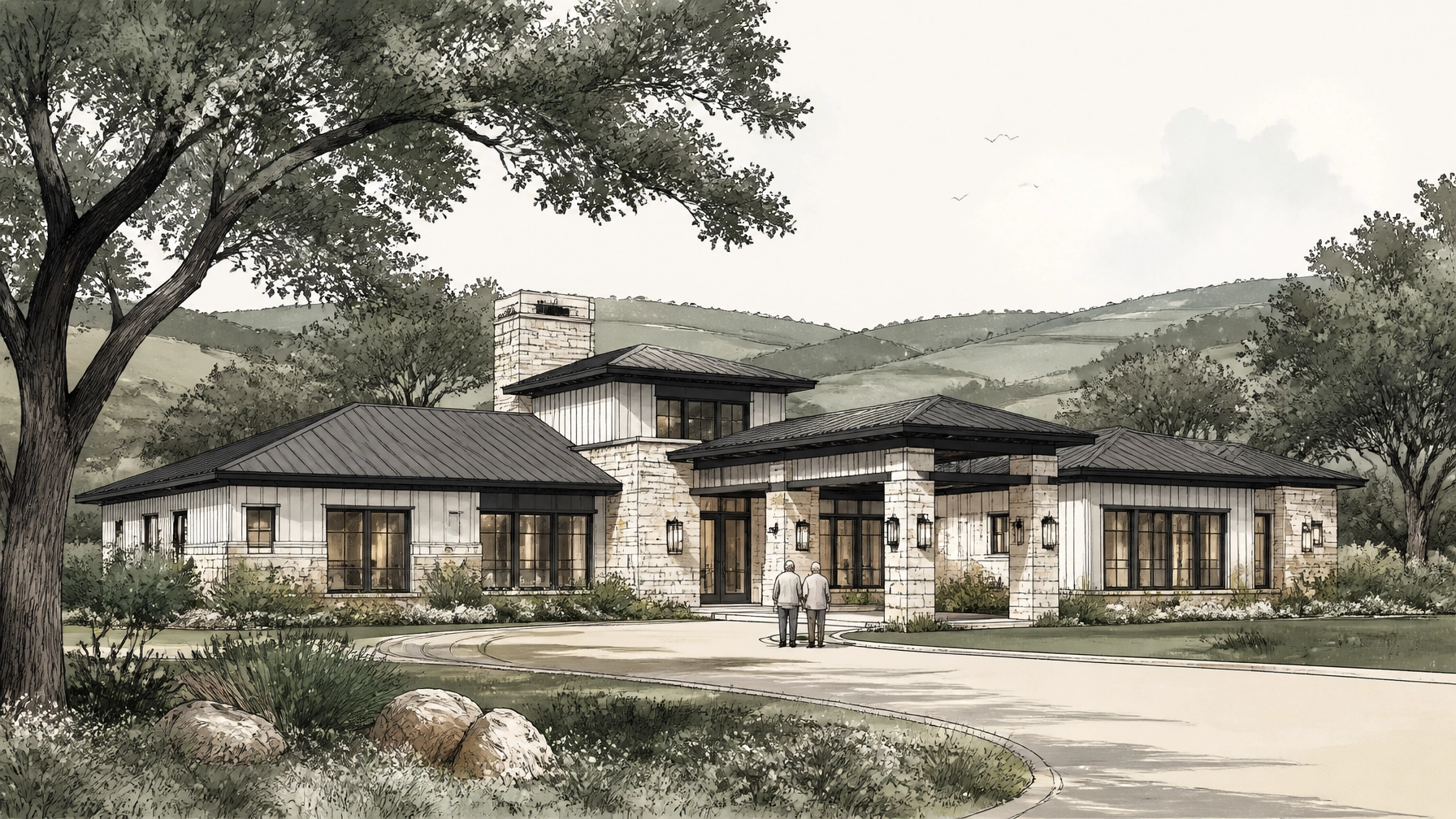
For as long as Sarah and I have talked about retiring to the Texas Hill Country, the image was always the same: ten acres outside of Fredericksburg, a long gravel driveway, and enough space between us and our nearest neighbor that we could watch the sunset in total silence. We wanted the "Ranch Life." We wanted the rugged independence that defines this part of Texas.
But six months ago, we signed the papers on a three-bedroom home in a master-planned 55+ community near Boerne.
It wasn't an easy decision. In fact, there was a week in the middle of our search where we almost walked away from the community entirely to put an offer on a beautiful piece of acreage near Wimberley. If you are currently caught between the allure of wide-open spaces and the convenience of a social hub, our journey might help you navigate that same fork in the road.
The Siren Call of the Texas Ranch
There is something deeply romantic about owning land in the Hill Country. When we first started touring properties, we weren't looking at floor plans; we were looking at "viewsheds" and soil quality. We visited a stunning 15-acre plot that had a dry creek bed and a grove of ancient cedar elms.

The appeal was simple: Freedom. On a ranch, there is no HOA telling you what color your front door can be. There are no shared walls, no communal noise, and no "organized fun." We imagined building a custom modern farmhouse, perhaps like those we saw in our Modern Farmhouse vs. Classic Stone aesthetic guide. We wanted a place where the grandkids could run wild and where we could truly "unplug."
For a moment, we were convinced. We even started looking into the logistics of transitioning from a high-rise to a ranch. But then, we started asking the hard questions: the ones that didn't involve sunsets and wine on the porch.
The "Almost" Moment: Why We Nearly Changed Our Minds
About halfway through our search, we visited a popular 55+ community. Walking through the model homes, a wave of "Buyer’s Remorse" hit me: and I hadn't even bought anything yet. I looked at the neatly manicured lawns and the rows of similar-looking houses and felt a sudden pang of claustrophobia.
"Is this it?" I whispered to Sarah. "Are we ready to be 'put out to pasture' in a neighborhood where everyone is the same age?"
We almost called our realtor that afternoon to pivot back to the acreage. We felt that by choosing a community, we were giving up our identity as "adventurous" retirees. We were worried about the "cookie-cutter" feel that some critics warn about.
However, before we made the leap back to the wild, we decided to do a "reality audit" of what ranch life actually entails as you move into your late 60s and 70s.
The Reality of the Maintenance
The turning point for us was a conversation with a friend who had retired to a 20-acre spread near Dripping Springs five years prior. He loved his land, but his "retirement" looked a lot like a full-time job as a groundskeeper.

He walked us through the "un-fun" parts of ranch ownership:
- The Infrastructure: On a ranch, you are the utility company. If the well pump fails at 10 PM on a Friday, it's your problem. If the septic system needs servicing, you’re the one coordinating the trucks.
- The Land Management: "The Hill Country is beautiful," our friend told us, "until the cedar fever hits and the brush needs clearing." Between fire mitigation and keeping the driveway from washing out during a flash flood, the physical toll is real.
- The Isolation: While we loved the idea of "social life in the sticks," the reality is that building a community when your neighbor is a mile away requires immense effort.
We realized that while we wanted the view of the ranch, we didn't necessarily want the vocation of the rancher. We wanted to spend our retirement traveling, not managing a cedar clearing crew.
Finding "Home" in the Community
We went back to the 55+ community with a different set of eyes. This time, we didn't look at the houses; we looked at the people.

We saw a group of men gathering for a morning bike ride. We saw a wine-tasting club meeting at the outdoor pavilion. We realized that the lock-and-leave lifestyle wasn't a surrender; it was a strategy. By choosing a community, we were outsourcing the "work" of homeownership so we could focus on the "joy" of retirement.
The social benefits were the final clincher. In a 55+ community, you aren't just buying a house; you are buying into an ecosystem of potential friends who are in the exact same season of life. We realized that as we aged, having a fitness center and a pickleball court a five-minute walk away was more valuable than having ten acres we couldn't walk across comfortably in ten years.
The Financial Perspective: Liquidity and Lifestyle
Beyond the lifestyle choice, there was a significant financial component. When we sat down with our team at Mau Sanchez Capital, the discussion shifted from "What can we afford?" to "What provides the best long-term flexibility?"
Building a custom home on a large ranch is a capital-intensive project. Often, a significant portion of a retiree's net worth gets "locked up" in the land and the structure. Rural luxury properties can also take longer to sell if you ever need to move closer to specialized medical care or family.

By choosing a home in a master-planned community, we were able to:
- Maintain Liquidity: We spent less on the home than we would have on a custom build/acreage combo, leaving more of our assets in the public markets where they can remain transparent, liquid, and part of a disciplined asset allocation.
- Predict Expenses: The HOA fee, while an added monthly cost, acts as a "cap" on maintenance surprises. We know exactly what our lifestyle costs every month.
- Focus on Growth: Rather than pouring capital into "non-productive" assets like fences and well repairs, we could keep our retirement portfolio focused on long-term equity ownership and risk management.
As Mau Sanchez often reminds his clients, a retirement portfolio should be a tool that serves your life, not a complex puzzle that requires constant management. We wanted that same philosophy for our home.
Final Thoughts: The Right Choice for Us
We still go out to Fredericksburg for the wineries and to Wimberley for the hiking. We still love the wildness of the Hill Country. But at the end of the day, we drive back to a home where the grass is cut, the pool is clean, and our friends are just a few doors down.
The "Ranch Life" is a beautiful dream, and for some, it is the perfect reality. But for us, the 55+ community offered the one thing we valued more than privacy: Time.
If you’re struggling with this same decision, I highly recommend talking to a fiduciary who understands the intersection of lifestyle and wealth preservation.
Schedule a private meeting with a fiduciary financial advisor today by calling (512) 593-8380 or by visiting: https://calendly.com/portafoliocapital/15min
Portafolio Capital Management dba Mau Sanchez Capital is a Registered Investment Adviser. This content is for informational purposes only and does not constitute investment advice or a solicitation to buy or sell any security. Advisory services are provided only pursuant to a written advisory agreement.
This article may include stories, scenarios, and perspectives created or assisted by artificial intelligence. Although the individuals and circumstances described may be fictional, the topics are intended to reflect real financial, personal, and lifestyle issues that retirees and individuals commonly face. The content is provided to encourage readers to consider different perspectives that may affect their retirement, regardless of whether they are currently planning, approaching retirement, or already retired. It is intended for general educational and informational purposes only and should not be interpreted as personalized investment, financial, tax, legal, medical, or retirement-planning advice. Individual circumstances vary. Readers should independently verify any information presented and consult appropriately qualified professionals before making financial or personal decisions. No advisory, professional, or client relationship is created through the use of this website.
Leave a Reply