
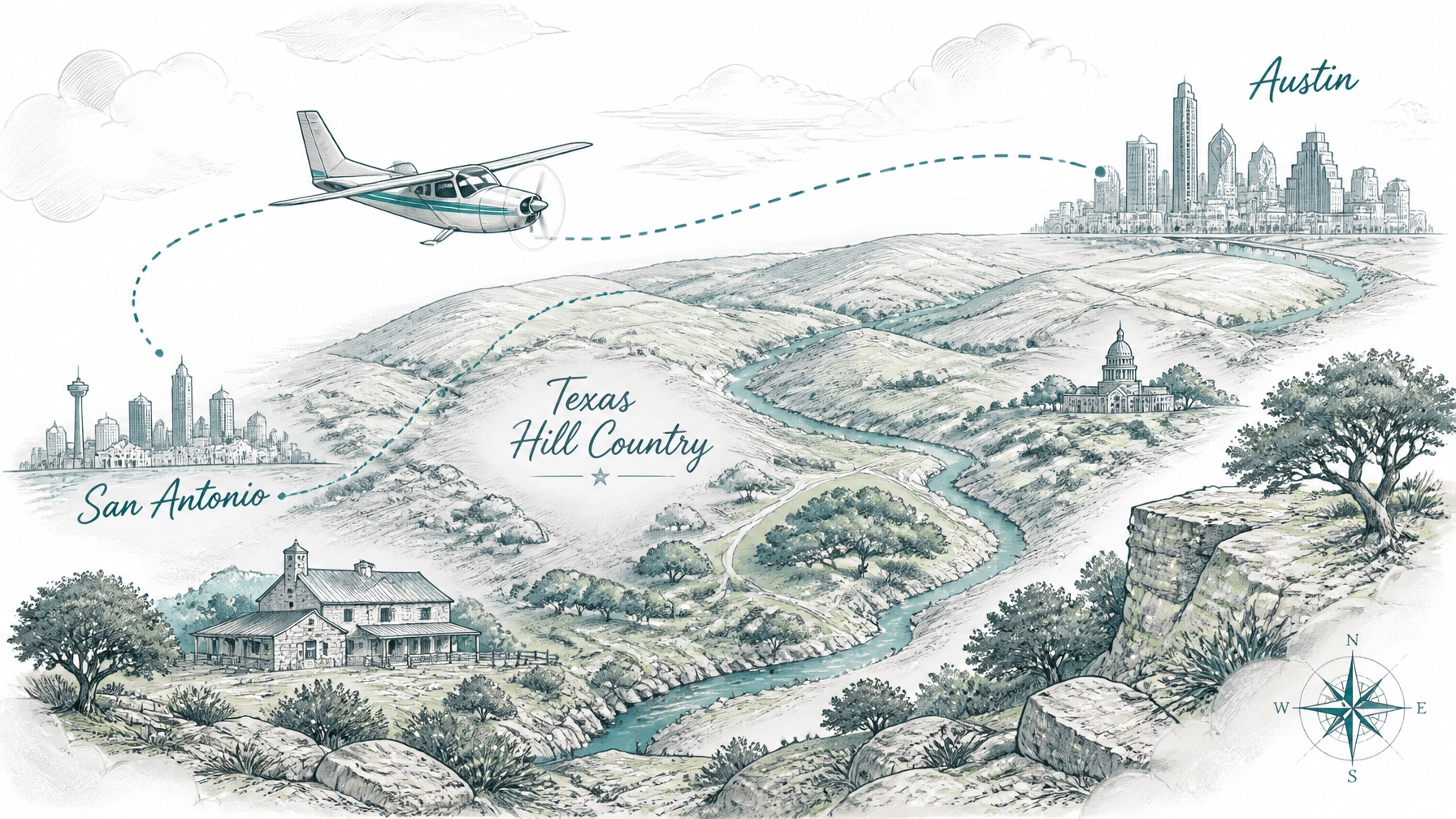
For many couples considering a Texas Hill Country retirement, airport access starts as a practical question—
How far will we have to drive to catch a flight?
It is an important question, but it should not be the only one. The best retirement location is not necessarily the town closest to an airport. It is the place that fits your everyday lifestyle while keeping travel manageable when you visit family, take a trip, or need to leave town for an extended period.
The two major commercial airports serving the region are San Antonio International Airport (SAT) and Austin-Bergstrom International Airport (AUS). Each offers different advantages, and the better choice often depends on where you want to live, how often you expect to fly, and whether your travel is primarily domestic or international.
Start with your travel habits, not the map
A frequent mistake is choosing a town based on an airport distance that looks convenient on paper but does not reflect how you actually live.
Some retirees fly several times a year to visit children and grandchildren. Others take one major vacation annually and spend the rest of their time enjoying local wineries, restaurants, golf courses, trails, and community events. Couples may also have different travel habits: one person may travel frequently for family or business while the other prefers to remain close to home.
A retiree travel survey from 451 Alliance reported an average of 3.24 trips during the prior year, while 41% of respondents identified airplanes as their primary travel method. That does not mean every retiree takes three flights annually, but it offers useful perspective—air travel matters to many retirees, though it is not necessarily a weekly part of retirement life.
Before comparing towns, ask:
- How many round trips do we expect to take each year?
- Will we usually check bags or travel with carry-ons?
- Do we prefer nonstop flights, even if the drive is longer?
- Are international trips a regular part of our plans?
- Will family members be flying in to visit us?
- Are we comfortable asking someone else to drive us to the airport?
Your answers may change which airport, and which side of the Hill Country, makes the most sense.
SAT versus AUS—convenience and flight variety
San Antonio International Airport is often the natural choice for communities west and northwest of San Antonio, including Boerne, Comfort, and parts of the western Hill Country. Its official nonstop destination list includes major domestic hubs such as Dallas-Fort Worth, Atlanta, Denver, Houston, Chicago, and Phoenix, along with several destinations in Mexico and Canada.
SAT can be especially practical when your travel is mainly domestic or when you are comfortable connecting through a larger hub. For some residents, the shorter drive is more valuable than having the largest possible list of nonstop routes.
Austin-Bergstrom International Airport generally offers a broader range of nonstop destinations, including more international options. The official AUS nonstop flight page lists service to destinations such as London, Amsterdam, Frankfurt, Mexico City, Toronto, Vancouver, and numerous cities throughout the United States.
That broader network may matter if you travel internationally, want more options for visiting distant family, or prefer to avoid connections. However, route schedules change. AUS notes that its airline information is updated monthly, and SAT similarly advises travelers that schedules are subject to change.
“Schedules are subject to change and please check with the airline for further information.” — San Antonio International Airport
The practical lesson is simple—compare the routes you actually use, not just the number of cities listed on an airport website.

How airport access varies by Hill Country town
Drive times depend on your exact address, the route you take, construction, and the time of day. Treat the following as planning ranges rather than guarantees.
Boerne—a strong SAT-side option
Boerne is one of the most convenient Hill Country communities for regular access to SAT. Many areas of town are roughly 30 to 45 minutes from San Antonio International Airport under favorable traffic conditions.
That proximity can be appealing for couples who travel several times a year but still want historic downtown charm, restaurants, parks, and a more relaxed pace than central San Antonio. The trade-off is that Boerne’s growing popularity and access to the San Antonio metro can bring more development and traffic than a smaller, more remote community.
Comfort—more country, longer airport days
Comfort generally provides a quieter and more rural atmosphere than Boerne. SAT may be approximately 45 to 60 minutes away, depending on your location and traffic.
For couples who fly occasionally, that may be a reasonable exchange for more open space, small-town character, and access to the western Hill Country. If one partner travels monthly, however, the airport drive may become a recurring source of frustration.
New Braunfels—positioned between both airports
New Braunfels offers an interesting middle ground. It is often within roughly 35 to 50 minutes of SAT and approximately 45 to 60 minutes of AUS, although traffic can change the experience considerably.
This makes New Braunfels attractive to couples who want flexibility. It also offers a lively mix of river recreation, restaurants, historic areas, and community amenities. The trade-off is that growth along the I-35 corridor can make drive times less predictable, especially during peak periods.
Our earlier comparison, “My Friend Retired to New Braunfels. I Chose Boerne. Here’s How We Compare Notes,” explores how the two communities differ beyond airport access.
Wimberley and Dripping Springs—AUS-side lifestyle choices
Wimberley is commonly viewed as an AUS-side community, with airport drives often falling into the 45- to 60-minute range. Its appeal is tied closely to nature, art, music, and a slower pace.
Dripping Springs can offer somewhat easier access to AUS, often within approximately 35 to 50 minutes depending on the neighborhood and traffic. It also provides wineries, upscale homes, outdoor activities, and proximity to Austin’s cultural and medical resources.
Both communities may work well for couples who fly a few times a year and value scenery more than being near a major airport. If you are considering Dripping Springs, our article “I Retired at 62 and Moved to Dripping Springs” looks at the adjustment beyond the initial appeal.
Fredericksburg—prioritize the lifestyle first
Fredericksburg is often about 75 to 90 minutes from either major airport, depending on the route and traffic. That is a meaningful drive, especially for an early-morning departure or a late-night return.
For some couples, the distance is worthwhile. Fredericksburg offers a distinctive combination of German heritage, wineries, galleries, restaurants, ranch-style living, and small-town tourism. For others, the airport trip may become too burdensome over time.
Fredericksburg may be a better fit for people who fly occasionally, prefer extended trips rather than frequent weekend travel, or are willing to book a hotel near the airport before an early departure.

The drive is only one part of the airport experience
A 45-minute drive does not necessarily equal a 45-minute airport experience. Add time for:
- Leaving home and loading luggage
- Parking or arranging a ride
- Walking or taking a shuttle to the terminal
- Security lines
- Boarding requirements
- Traffic or construction delays
- Returning home after a long travel day
A drive that feels easy on a quiet Sunday afternoon may feel entirely different on a weekday morning. Before choosing a property, test the route at the times you are most likely to travel.
TxDOT’s DriveTexas map can help you review current construction, closures, and incidents. The TxDOT San Antonio District travel-time map can also provide useful information for corridors such as US 281 and I-35.
Do not just measure the distance from a town center. Test the route from the neighborhoods or acreage areas you are seriously considering.
A practical distance guide for relocating couples
As a general lifestyle framework:
- One or two flights per year — A 60- to 90-minute airport drive may be acceptable if the community is an excellent fit.
- Three to five trips per year — A 45- to 60-minute drive may offer a comfortable balance.
- Monthly travel or frequent family visits — Consider staying within roughly 30 to 45 minutes of your preferred airport.
- Frequent international travel — AUS may deserve extra consideration because of its broader nonstop network.
- Mostly domestic travel — SAT may provide sufficient service, particularly if it is substantially closer to your preferred town.
These are not rules. They are starting points for a conversation between convenience and lifestyle.

The best airport may not be the closest one
Airport access matters, but it should be weighed alongside the features that shape your other 360 days each year—
- Walkability and access to daily services
- Medical care and specialist availability
- Restaurants, wineries, and cultural activities
- Outdoor recreation
- Home maintenance and property considerations
- Proximity to friends and family
- The pace and character of the community
A couple who flies twice a year may regret giving up their ideal Hill Country setting just to save 25 minutes on an airport drive. A couple who travels every month may regret choosing a beautiful but remote property that turns every trip into an exhausting day.
The right question is not simply, “How close are we to SAT or AUS?”
It is “How much airport convenience do we need to support the retirement lifestyle we actually want?”
Schedule a private meeting with a fiduciary financial advisor today by calling (512) 593-8380 or by visiting: https://calendly.com/portafoliocapital/15min
Portafolio Capital Management dba Mau Sanchez Capital is a Registered Investment Adviser. This content is for informational purposes only and does not constitute investment advice or a solicitation to buy or sell any security. Advisory services are provided only pursuant to a written advisory agreement.
This article may include stories, scenarios, and perspectives created or assisted by artificial intelligence. Although the individuals and circumstances described may be fictional, the topics are intended to reflect real financial, personal, and lifestyle issues that retirees and individuals commonly face. The content is provided to encourage readers to consider different perspectives that may affect their retirement, regardless of whether they are currently planning, approaching retirement, or already retired. It is intended for general educational and informational purposes only and should not be interpreted as personalized investment, financial, tax, legal, medical, or retirement-planning advice. Individual circumstances vary. Readers should independently verify any information presented and consult appropriately qualified professionals before making financial or personal decisions. No advisory, professional, or client relationship is created through the use of this website.
Leave a Reply