
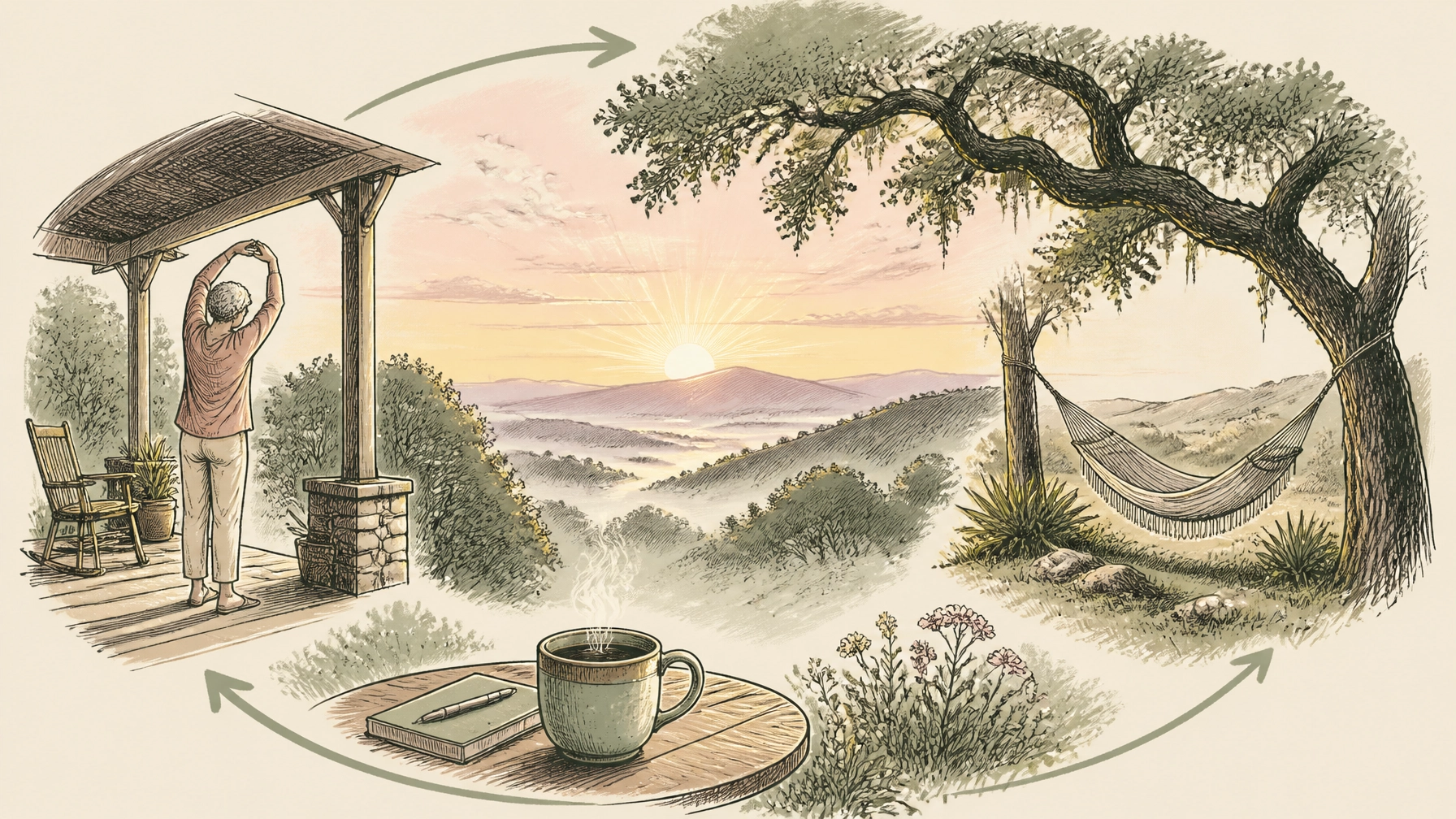
When I think about a peaceful Texas Hill Country retirement, I do not picture an endless vacation. I picture something more practical—and potentially more valuable.
I picture waking up without an alarm, stepping onto a shaded porch with a cup of coffee, taking a walk before the Texas heat arrives, and knowing the people I pass along the way. I picture afternoons that leave room for gardening, reading, golf, art, or a long lunch. I picture evenings that are quiet enough to hear the wind moving through the oaks.
That kind of slower pace is not simply attractive. It may also support the everyday habits associated with healthier aging—consistent sleep, regular movement, exposure to daylight, lower stress, and meaningful social connection.
Of course, no community or lifestyle can guarantee a longer life. Health is shaped by genetics, medical care, environment, habits, and circumstances. But the Hill Country can make certain healthy routines feel natural rather than forced. For many retirees, that may be one of its greatest advantages.
Longevity Is About Healthspan, Not Just Lifespan
The word “longevity” is often used to describe living longer. But the more meaningful goal is usually a longer healthspan—more years of moving comfortably, thinking clearly, remaining independent, and participating in the activities and relationships that make life fulfilling.
Harvard Health identifies five lifestyle patterns that consistently appear in longevity research: movement, nutrition, sleep, stress management, and social connection. As Dr. David Barzilai explains, “What we actually want is both more years and more of those years lived in good health.”
That idea changes how I view retirement relocation. The question is not only, “What will my house look like?” It is also:
- Will my daily environment encourage movement?
- Will I have access to sunlight and nature?
- Will I develop a reliable social rhythm?
- Will my home and community help me sleep well?
- Will my lifestyle reduce unnecessary stress instead of adding to it?
These questions are especially important when comparing communities such as Boerne, Wimberley, Fredericksburg, Dripping Springs, and New Braunfels.
Sleep—The Quiet Foundation of Healthy Aging
Retirement can create more freedom, but it does not automatically create better sleep. A new home, an unfamiliar town, changing routines, health concerns, and financial uncertainty can all interfere with rest.
That is why the most appealing part of the Hill Country pace may be its potential to support consistency.
Without a daily commute, late office meetings, or a calendar packed from morning through evening, retirees may have more room to establish a regular sleep schedule. A slow morning can reduce the temptation to rush through breakfast, skip movement, or begin the day already feeling behind.
Harvard Health notes that adults generally need about seven to eight hours of sleep each night, while consistency—including a steady wake time—may be especially important. Sleep supports memory, stress regulation, appetite hormones, and the body’s routine maintenance.

The Hill Country is not a cure for insomnia, sleep apnea, or other medical conditions. Anyone experiencing persistent sleep problems should speak with a qualified medical professional. But a retirement lifestyle with fewer artificial deadlines can make healthy sleep habits easier to practice.
A morning routine might be simple:
- Wake at approximately the same time each day.
- Open the blinds or step outdoors for natural light.
- Take a short walk or complete gentle movement.
- Enjoy breakfast without immediately checking email or news.
- Let the day unfold at a sustainable pace.
These habits may sound ordinary. That is part of the point. Healthy aging is often built through ordinary routines repeated over many years.
Sunlight and the Body’s Internal Clock
One of the most noticeable differences between city living and the Texas Hill Country is the relationship with outdoor light.
In a dense urban environment, it can be easy to spend most of the day indoors, moving from a dim bedroom to a car, office, restaurant, or shopping center. In the Hill Country, sunlight is part of the landscape. It arrives through the windows, stretches across limestone walls, and changes the appearance of the hills throughout the day.
Morning light is particularly relevant to sleep and wellness because it helps regulate the body’s circadian rhythm—the internal timing system that influences wakefulness and sleep. Regular exposure to natural light during the day may also support mood and daily alertness.
A 2026 study summary published in Frontiers in Public Health reported associations between sunlight exposure, sleep, and multimorbidity in older adults. The findings do not prove that sunlight alone prevents illness, but they reinforce the importance of looking at daily routines as a whole.
There is also a practical benefit—daylight invites people outside.
A walk after breakfast, time spent tending native plants, or coffee on the porch can become a reliable transition into the day. And when outdoor time is connected to movement, conversation, or nature, one healthy behavior can reinforce another.
Sun safety still matters, especially during Texas summers. Retirees should consider shade, hydration, protective clothing, sunscreen, and the timing of outdoor activities. In many Hill Country communities, early mornings and late afternoons offer a more comfortable window for walking and other outdoor activities.
Outdoor Living Makes Movement Feel Less Like Exercise
I have noticed that people are more likely to stay active when movement is connected to something they enjoy.
A walk to a coffee shop feels different from a workout on a machine. Gardening can provide light physical activity while creating a sense of accomplishment. Exploring a trail, browsing a farmers market, visiting a winery, or strolling through a historic downtown can add movement to the day without making it feel like another obligation.

Research on older adults has associated regular outdoor time with better self-reported physical functioning, fewer depressive symptoms, and less fear of falling. Again, these are associations rather than guarantees. Individual abilities and medical conditions vary. But the larger lesson is useful: Access to pleasant outdoor spaces can encourage people to leave the house and move more often.
That matters because movement supports much more than physical strength. Harvard Health describes movement as a broad health signal connected to cardiovascular fitness, bone density, insulin sensitivity, and brain health. Everyday movement also counts, particularly when it breaks up long periods of sitting.
A retirement community does not have to be built around intense athleticism. It may simply need:
- Sidewalks or paths that feel comfortable to use
- Shaded outdoor gathering areas
- Parks, trails, or nearby natural spaces
- Places to walk for errands or social activities
- Outdoor programs that welcome different fitness levels
- Homes designed for easy access to porches, patios, and gardens
The best environment is often the one that makes the healthy choice convenient.
A Slower Pace Can Help Lower Chronic Stress
Retirement is not automatically stress-free. In fact, leaving work can introduce new concerns about purpose, identity, health, family responsibilities, and spending. But the pace of daily life can influence how those concerns are experienced.
Chronic stress becomes especially difficult when the body never seems to leave a state of alertness. Harvard Health describes prolonged stress as something that can disrupt sleep, metabolism, cardiovascular health, and immune function over time.
The Hill Country pace may provide more opportunities to interrupt that cycle.
A slower morning can create space between waking and reacting. A walk beneath live oaks can provide a mental reset. A conversation with a neighbor can replace the feeling of moving through the day alone. Even a quiet drive through the hills can become a reminder that not every moment needs to be optimized.
This does not mean retirees need to withdraw from activity. The healthiest version of slow living is not inactivity. It is intentionality.
It means choosing a rhythm that leaves room for restoration, rather than filling every hour simply because the calendar is available.
Community Is Part of the Wellness Plan
One of the most important—and most overlooked—aspects of retirement relocation is the social environment.
A beautiful view can improve a morning, but it cannot replace friendship, purpose, or belonging. A retirement community should offer opportunities to develop recurring relationships, whether through volunteer work, faith communities, clubs, classes, walking groups, local events, or shared meals.

Research summarized by the Population Reference Bureau found that older adults with stronger social connections tend to be healthier and live longer than socially isolated peers. The report also notes that supportive relationships may affect stress, memory, health behaviors, and sleep.
The key word is recurring. A one-time event can be enjoyable, but a weekly class or regular morning walk gives relationships a chance to develop naturally.
As one Harvard Health recommendation puts it, social connection should be protected “like an appointment.” That is a useful way to think about relocation. Do not wait until after the move to ask how you will build community. Investigate the rhythm of local life beforehand.
Are there places where people gather? Are events accessible? Can you imagine becoming a familiar face somewhere?
Our earlier look at building community when your nearest neighbor is a mile away explores why social connection often requires intention in rural and semi-rural settings. The same principle applies throughout the Hill Country.
Designing a Retirement That Supports the Life You Want
The appeal of a peaceful Texas Hill Country retirement is not just the scenery. It is the possibility of creating a daily life aligned with your priorities.
Before choosing a town or home, I would consider the small details that shape wellness over time:
- Where will you get morning light?
- Can you safely walk near your home?
- How far will you travel for medical appointments and essential services?
- What activities will bring you into contact with the same people regularly?
- Will the home require more maintenance than you want?
- Does the community support the pace you envision?
- Can your financial plan support the lifestyle without creating ongoing stress?
These questions connect lifestyle and retirement planning. A home with acreage may offer privacy and beauty, but it can also bring maintenance demands. A property near a walkable downtown may provide convenience and social interaction, but perhaps less space. A smaller home may simplify daily life, while a larger home may better support visiting family.
There is no universal answer. The right choice depends on your health, preferences, family, and financial circumstances.
For readers thinking through the broader transition, this first-person account of moving to Dripping Springs offers another perspective on the emotional adjustment that can follow a retirement relocation.
The Hill Country Pace Is an Invitation, Not a Guarantee
Sleep, sunlight, outdoor living, and community connection are not magic formulas. They cannot replace medical care, nutrition, appropriate exercise, or individualized guidance. But they can form the foundation of a retirement lifestyle that supports healthspan and daily enjoyment.
That is what makes the Hill Country so compelling to many retirees. The landscape encourages people to step outside. The small-town rhythm creates opportunities to slow down. The local culture makes room for shared meals, music, art, wine, conversation, and time with neighbors.
A meaningful retirement may not require a more complicated life. It may require a more intentional one.
Sometimes, longevity-supporting habits begin with something as simple as sleeping on a regular schedule, watching the sunrise, walking beneath the oaks, and having somewhere to be where people know your name.
Schedule a private meeting with a fiduciary financial advisor today by calling (512) 593-8380 or by visiting: https://calendly.com/portafoliocapital/15min
Portafolio Capital Management dba Mau Sanchez Capital is a Registered Investment Adviser. This content is for informational purposes only and does not constitute investment advice or a solicitation to buy or sell any security. Advisory services are provided only pursuant to a written advisory agreement.
This article may include stories, scenarios, and perspectives created or assisted by artificial intelligence. Although the individuals and circumstances described may be fictional, the topics are intended to reflect real financial, personal, and lifestyle issues that retirees and individuals commonly face. The content is provided to encourage readers to consider different perspectives that may affect their retirement, regardless of whether they are currently planning, approaching retirement, or already retired. It is intended for general educational and informational purposes only and should not be interpreted as personalized investment, financial, tax, legal, medical, or retirement-planning advice. Individual circumstances vary. Readers should independently verify any information presented and consult appropriately qualified professionals before making financial or personal decisions. No advisory, professional, or client relationship is created through the use of this website.
Leave a Reply