
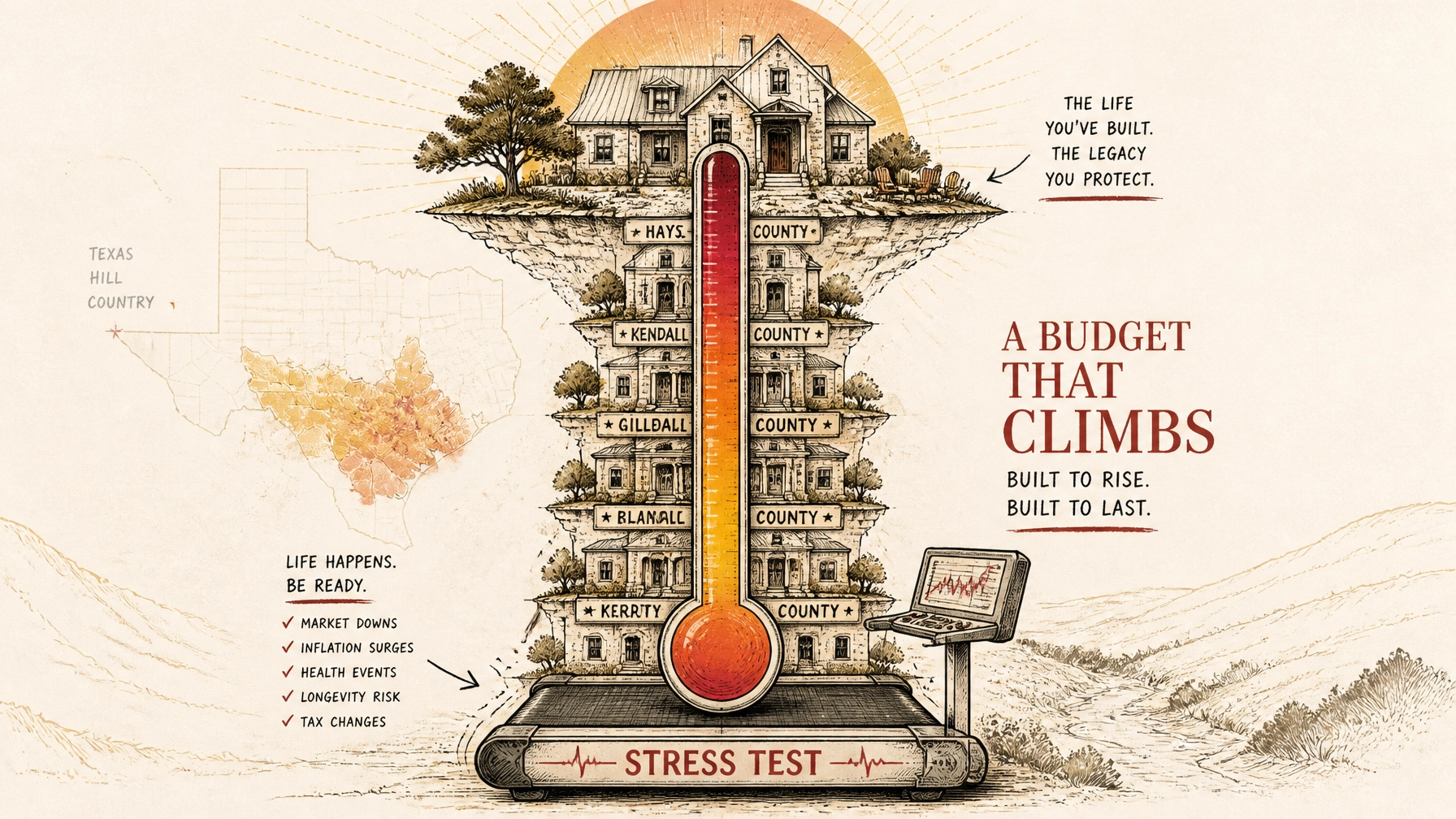
For many retirees, the Texas Hill Country dream includes a limestone home, a shaded porch, nearby wineries, walking trails, and enough room for family to visit. But the cost of enjoying that lifestyle is not limited to the purchase price.
Property taxes deserve a place near the top of your retirement-planning checklist.
A rising appraisal, a change in local tax rates, a new improvement, or the loss of an exemption can increase your annual housing costs. The goal is not to predict the exact bill years in advance. The goal is to build a retirement budget that remains comfortable if the bill is higher than expected.
That is what a stress test does.
First, understand what drives a Texas property tax bill
Texas property taxes are local rather than state-imposed. Your bill generally reflects three moving parts:
- The value assigned by your county appraisal district
- Exemptions that may reduce the taxable value
- Tax rates adopted by the county, school district, city, and other local taxing units
The Texas Comptroller explains that appraisal districts determine property values while local taxing units adopt tax rates. Your total bill may include charges from several entities, even if one county tax office sends the statement.
That distinction matters. A county appraisal district may increase the market value of your home, but it does not set the combined rate for your county, city, school district, or emergency service district.
Likewise, the homestead appraisal cap does not guarantee that your total bill will rise by no more than 10%. Once applicable, the cap generally limits annual growth in a qualifying residence homestead’s appraised value to 10%, plus the value of new improvements. It does not cap market value, tax rates, or the final tax bill. The Comptroller’s valuation guidance explains how those limitations work.
County-level examples from the Hill Country
The following examples use 2025 adopted county rates that were available through official county or appraisal district sources. They are illustrations of the county portion only, not a complete property tax bill.
Rates change, and the total rate for a particular property depends on its exact city, school district, and special districts.
| County | 2025 adopted county rate per $100 | County portion on $1 million taxable value |
|---|---|---|
| Kendall County | $0.3770 | $3,770 |
| Hays County | $0.3075 | $3,075 |
| Gillespie County | $0.2685 | $2,685 |
| Travis County | $0.344445 | Approximately $3,444 |
The Kendall County tax-rate information page lists the county’s 2025 adopted rate at $0.377 per $100. Gillespie County’s financial and tax-rate information lists an adopted 2025 rate of $0.2685 per $100. Hays County’s official rate documents report $0.3075 per $100, while Travis Central Appraisal District materials show a 2025 county rate of approximately $0.344445 per $100.
A $1 million property in Kendall County and a $1 million property in Gillespie County can therefore have different county-level tax costs before considering other taxing units.
This is one reason a broad statement such as “property taxes are lower in the Hill Country” is not enough for retirement planning. The specific address matters.
A practical three-scenario stress test
Consider a fictional couple planning to retire near Boerne. They own a home with a taxable value of $1.2 million and are using Kendall County’s 2025 county rate as a planning reference.
Their estimated county portion would be:
$1,200,000 ÷ 100 × $0.377 = $4,524 per year
That does not include the school district, city, or special districts. Now let’s test three possibilities.
Scenario 1: The appraisal rises by 10%
Assume the county rate stays the same but the taxable value rises by 10%.
- Starting taxable value: $1,200,000
- Stress-tested taxable value: $1,320,000
- Estimated county portion: $4,977.60
- Annual increase: Approximately $453.60
An increase of roughly $454 may be manageable for a household with strong monthly cash flow. It may be more meaningful for someone relying primarily on fixed retirement income.
Scenario 2: The rate rises by 5%
Assume the taxable value remains $1.2 million, but the county rate increases by 5%.
- Starting county portion: $4,524
- Stress-tested rate: Approximately $0.39585 per $100
- Estimated county portion: Approximately $4,750
- Annual increase: Approximately $226
Again, this is only the county portion. Local rate decisions by a school district or municipality could have a larger effect on the final bill.
Scenario 3: Value and rate rise together
Now combine the two assumptions:
- Taxable value increases by 10%
- County rate increases by 5%
- Estimated county portion: Approximately $5,226
- Annual increase: Approximately $702
A $702 increase may not sound dramatic in isolation. But add higher homeowners insurance, a roof replacement, vehicle expenses, healthcare premiums, and regular travel to see family, and the cumulative effect can change the character of a retirement budget.

Do not forget exemptions and the homestead rules
A qualifying Texas residence homestead may receive exemptions that reduce taxable value. The Texas Comptroller’s exemption guidance describes the statewide school district homestead exemption and additional provisions for homeowners who are 65 or older or disabled.
Homeowners who qualify for the over-65 exemption may also qualify for a school district tax ceiling. That ceiling is separate from the appraisal cap and applies to school district taxes, not necessarily every part of the total property tax bill.
Several details matter:
- You generally must own and occupy the property as your principal residence.
- The exemption and related protections may not apply immediately in every situation.
- A new home purchase can affect the timing of the homestead appraisal cap.
- Major additions or improvements may affect taxable value and, in some cases, a tax ceiling.
- Moving from one home to another may involve different rules for transferring certain benefits.
Because these provisions are administered through your local appraisal district, review your property record rather than relying on a general estimate.
Build the stress test into your lifestyle budget
A retirement budget should reflect how you intend to live in the Hill Country, not just your mortgage payment and grocery bill.
Start with your recurring lifestyle expenses:
- Property taxes
- Homeowners insurance
- Utilities and propane
- Well, septic, or road maintenance
- Landscaping and wildlife management
- Vehicle costs and longer driving distances
- Dining, wine-country outings, and entertainment
- Healthcare and prescriptions
- Travel and visits from family
- Home repairs and improvements
Then separate the expenses into three categories.
Essential and predictable
These include regular utilities, insurance premiums, groceries, healthcare, and the baseline property tax bill.
Variable but recurring
These may include fuel, dining, yard care, travel, and seasonal utility expenses.
Irregular and potentially large
This category includes a new roof, HVAC replacement, well repairs, storm damage, major plumbing work, or a substantial property tax increase.
Property taxes may be billed once or twice a year, but your retirement income arrives according to a different schedule. Convert the annual tax obligation into a monthly planning figure. A $6,000 annual bill is equivalent to setting aside $500 each month, even if the payment is not due monthly.
For a property with acreage or extensive improvements, consider a separate reserve for irregular property costs. This helps keep one large bill from forcing a sudden change in your travel, dining, or family plans.
Review the bill before assuming it is final
If your appraisal notice appears inconsistent with comparable homes or recent market conditions, review the information promptly. The Comptroller states that the usual protest deadline is “May 15 or 30 days after the appraisal district mails the notice of appraised value, whichever is later.”
The Texas Comptroller’s property tax protest page provides general information about the process. Your local appraisal district can explain the property record, filing requirements, and applicable deadlines.
This is not a reason to assume your value is wrong. It is a reminder to read the notice, verify that exemptions are reflected, and ask questions before the deadline passes.
For current adopted rates, use the Texas property tax transparency resources and the official websites for your county, city, school district, and special districts. If you are comparing communities such as Boerne, Wimberley, Fredericksburg, Dripping Springs, or New Braunfels, compare the complete taxing structure—not just a county rate.

Keep the retirement portfolio flexible
A stress-tested budget also considers where the money will come from if expenses rise.
For many retirees, maintaining adequate liquidity can reduce the pressure to sell long-term investments at an inconvenient time. A thoughtfully constructed portfolio may combine publicly traded stocks and traditional fixed income in a way that reflects the household’s income needs, time horizon, and tolerance for market fluctuations.
The emphasis should be on proper asset allocation, transparency, cost efficiency, and risk management through portfolio construction. Excessive fees, long lockups, and unnecessary complexity can make it harder to respond when property costs change.
A fiduciary financial planning conversation can help connect the home decision with the broader retirement-income picture. The question is not simply, “Can we afford this house today?” It is also, “Can our plan continue supporting this lifestyle if taxes, insurance, and maintenance costs rise together?”

The goal is confidence, not perfect prediction
No one can know the exact property tax bill a Hill Country homeowner will receive five or ten years from now. But you can create a useful range of outcomes.
Review your current bill, identify every taxing unit, confirm your exemptions, and model at least these possibilities:
- A 5% increase in the combined tax burden
- A 10% increase in taxable value
- A simultaneous increase in value and tax rates
- A major home improvement
- Higher insurance and maintenance costs in the same year
If your lifestyle remains comfortable under those scenarios, you may have a more durable retirement plan. If the budget becomes strained, you still have time to reconsider the home size, location, financing, portfolio structure, or cash reserves before making a move.
The Texas Hill Country can offer peaceful mornings, beautiful landscapes, and a slower pace of life. Stress-testing the costs before you retire helps ensure those benefits remain enjoyable long after moving day.
Schedule a private meeting with a fiduciary financial advisor today by calling (512) 593-8380 or by visiting: https://calendly.com/portafoliocapital/15min
Portafolio Capital Management dba Mau Sanchez Capital is a Registered Investment Adviser. This content is for informational purposes only and does not constitute investment advice or a solicitation to buy or sell any security. Advisory services are provided only pursuant to a written advisory agreement.
This article may include stories, scenarios, and perspectives created or assisted by artificial intelligence. Although the individuals and circumstances described may be fictional, the topics are intended to reflect real financial, personal, and lifestyle issues that retirees and individuals commonly face. The content is provided to encourage readers to consider different perspectives that may affect their retirement, regardless of whether they are currently planning, approaching retirement, or already retired. It is intended for general educational and informational purposes only and should not be interpreted as personalized investment, financial, tax, legal, medical, or retirement-planning advice. Individual circumstances vary. Readers should independently verify any information presented and consult appropriately qualified professionals before making financial or personal decisions. No advisory, professional, or client relationship is created through the use of this website.
Leave a Reply