
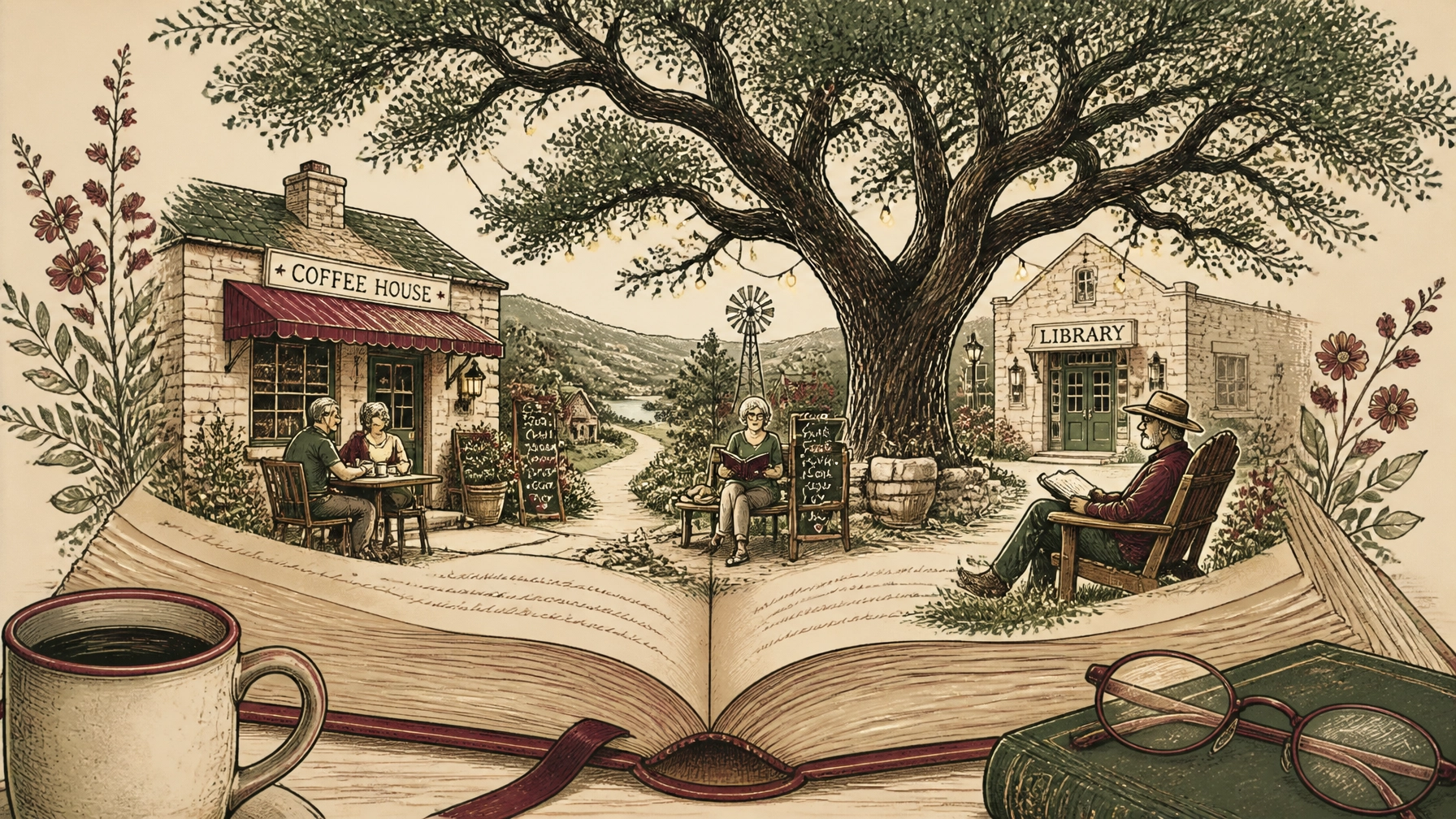
One of the most common concerns we hear from people considering a Texas Hill Country retirement is simple: “Will there be enough to do?”
The question is understandable. Moving from a major metro area can create anxiety about access to cultural events, classes, lectures, and meaningful social connections. A small town may not have a downtown theater district or a university campus on every corner.
But the idea that small-town life is intellectually quiet is often outdated.
Across communities such as Wimberley, Boerne, Fredericksburg, and New Braunfels, libraries, cultural organizations, local authors, historical groups, and community centers create a steady calendar of opportunities to learn. The scale may be smaller than Austin or San Antonio, but the conversations can be more personal, and participation is often easier.
For retirees, that combination can be especially appealing—a slower pace without giving up curiosity, creativity, or connection.
The library is often the center of community life
In many Hill Country towns, the public library is much more than a place to borrow books. It can function as a lecture hall, writing workshop, gathering place, history center, and informal classroom.
The Wimberley Village Library’s adult programs illustrate this especially well. Its current programming includes several recurring book clubs, a monthly author series, local-author displays, genealogy assistance, language classes, gardening presentations, and wellness programs.
The library’s “Face-to-Face with Area Authors” series, for example, gives residents an opportunity to hear directly from local writers and storytellers. The program is scheduled for the first Wednesday of each month, with conversations held in the Wimberley Community Room.
The library describes its programs simply: “Programs are free and open to the public.”
That accessibility matters. A retiree does not necessarily need to enroll in a formal university course or travel into a large city to keep learning. A nearby library may offer a thoughtful presentation on local history one week, a writing discussion the next, and a book club later in the month.

Book clubs offer more than reading recommendations
A book club is often described as a social activity, but it can also be a form of continuing education.
The best discussions move beyond whether participants enjoyed a book. They explore history, psychology, politics, family, culture, ethics, and the changing world around us. A well-chosen novel can introduce a different generation’s experience. A memoir can challenge assumptions. A mystery can become a conversation about justice, place, or human behavior.
New Braunfels provides a good example of how varied these groups can be. The New Braunfels Public Library’s book club guide lists several ongoing groups, including:
- A Fiction Book Group meeting on the second Wednesday of each month
- A Mystery Book Group meeting on the third Thursday afternoon
- Books on Tap, which meets on the third Thursday evening
- A Romance Book Group meeting on the fourth Wednesday evening
The reading lists span contemporary fiction, classics, mysteries, speculative fiction, fantasy, and romance. That variety is important because there is no single definition of an “intellectual” interest.
Some people want to discuss Toni Morrison or historical nonfiction. Others would rather analyze a mystery’s structure or compare how a novel was adapted for the screen. Intellectual vitality does not require everyone to enjoy the same books. It requires a community where people remain interested in ideas.
Book clubs also create an easy point of entry for newcomers. Instead of trying to build an entire social network from scratch, a new resident can attend one meeting, listen to the conversation, and gradually become part of the group.
Small towns have their own lecture circuit
Large cities tend to advertise cultural events through major institutions. Small towns often distribute them through libraries, historical societies, museums, arts organizations, churches, community centers, and local newsletters.
The result is a less centralized but surprisingly active lecture circuit.
In Fredericksburg, Pioneer Memorial Library provides a natural starting point for discovering library programming and community events. Its broader program listings have included history-focused series, book clubs, author talks, and other educational activities.
Fredericksburg’s German heritage, military history, wine culture, and connection to the surrounding ranch country provide plenty of subjects for public talks. A resident might spend one afternoon learning about local architecture, another discussing World War history, and another attending a presentation from a Hill Country author.
Boerne offers another strong example. The Boerne Book Festival is scheduled for October 3, 2026, at Patrick Heath Public Library. The event includes author discussion panels, book signings, and literary programming.
The festival’s invitation is direct: “Join booklovers from around Texas” for a full day of literary events.
That kind of gathering demonstrates something important about small-town culture. Residents are not merely consuming entertainment. They are meeting writers, asking questions, exchanging recommendations, and participating in conversations that extend beyond the event itself.

Writing groups turn experience into contribution
Reading is only one side of a rich intellectual life. Many retirees discover that they want to write as well.
Retirement often creates space to work on a memoir, family history, collection of essays, poetry, or even a novel that has been waiting for decades. Others want to write about the places they know—ranch life, military service, a career in business, raising a family, or moving across the country.
Writing groups can provide structure and encouragement. They also create accountability. It is easier to complete several pages when you know other people will ask about your progress next month.
Wimberley’s adult programming includes a recurring writers’ group called “Do the Write Thing!” and has also hosted author conversations focused on the practical side of publishing. One recent program featured a live question-and-answer session about turning a manuscript into a paperback or Kindle book.
The value of these groups is not limited to aspiring professional authors. Writing can help retirees preserve memories, organize family stories, and make sense of a major life transition. A critique group can also become a close social circle, particularly for someone who prefers thoughtful conversation to large gatherings.
Small towns frequently make these groups feel more accessible. Participants may be neighbors, local business owners, teachers, artists, veterans, and newcomers. The setting is informal, but the work can be serious.
Lifelong learning can be woven into everyday life
A fulfilling retirement does not have to be built around a packed schedule. In fact, one of the benefits of Hill Country living is the ability to create a rhythm that balances activity with quiet.
A typical month might include:
- A book club discussion at the local library
- A lecture on Texas history or regional conservation
- A writing group focused on memoir or fiction
- A visit to a museum, gallery, or author event
- A class in Spanish, gardening, genealogy, or another personal interest
- Time at home to read, write, or continue the conversation
This is different from the “nothing to do” stereotype. It is a lifestyle built around choosing activities intentionally rather than filling every evening with commercial entertainment.
The Hill Country’s art and winery culture can complement this intellectual life. A conversation with a local artist, a tasting-room discussion about regional agriculture, or a visit to a historic site can become part of a broader interest in place and culture.

How to evaluate a town’s intellectual life before moving
If lifelong learning is important to your retirement, add it to your relocation checklist. During a visit, consider:
- Does the local library have an active adult calendar?
- Are there recurring book clubs, author talks, or lecture series?
- Do community centers offer classes or discussion groups?
- Are historical societies, museums, or arts organizations active?
- Is there a nearby college or larger city with public programming?
- Are events held during the daytime, evening, or both?
- Would you feel comfortable attending alone?
- Are programs free, membership-based, or fee-based?
- Do residents participate, or are events primarily designed for visitors?
It is also worth checking calendars more than once. Small-town programming can change seasonally, and some groups are promoted through email newsletters or community bulletin boards rather than large event websites.
Most importantly, ask residents what they actually attend. A website may list a dozen programs, but a conversation with a librarian or local business owner can reveal which groups are welcoming, consistent, and genuinely active.
The quieter side of an active retirement
The intellectual life of a small town may not announce itself with flashing signs. It may appear as a handwritten event flyer, a full library meeting room, or a group of neighbors debating a novel over coffee.
That understated quality is part of the appeal.
For retirees and pre-retirees considering Boerne, Wimberley, Fredericksburg, New Braunfels, or surrounding communities, the question is not whether small towns offer meaningful things to do. The better question is which kind of community best matches your interests, energy, and preferred pace.
A peaceful retirement can still be an engaged retirement. There is room for quiet mornings, scenic drives, winery visits, and time on the porch—as well as books, lectures, new skills, and ideas that keep life expanding.
Schedule a private meeting with a fiduciary financial advisor today by calling (512) 593-8380 or by visiting: https://calendly.com/portafoliocapital/15min
Portafolio Capital Management dba Mau Sanchez Capital is a Registered Investment Adviser. This content is for informational purposes only and does not constitute investment advice or a solicitation to buy or sell any security. Advisory services are provided only pursuant to a written advisory agreement.
This article may include stories, scenarios, and perspectives created or assisted by artificial intelligence. Although the individuals and circumstances described may be fictional, the topics are intended to reflect real financial, personal, and lifestyle issues that retirees and individuals commonly face. The content is provided to encourage readers to consider different perspectives that may affect their retirement, regardless of whether they are currently planning, approaching retirement, or already retired. It is intended for general educational and informational purposes only and should not be interpreted as personalized investment, financial, tax, legal, medical, or retirement-planning advice. Individual circumstances vary. Readers should independently verify any information presented and consult appropriately qualified professionals before making financial or personal decisions. No advisory, professional, or client relationship is created through the use of this website.
Leave a Reply