
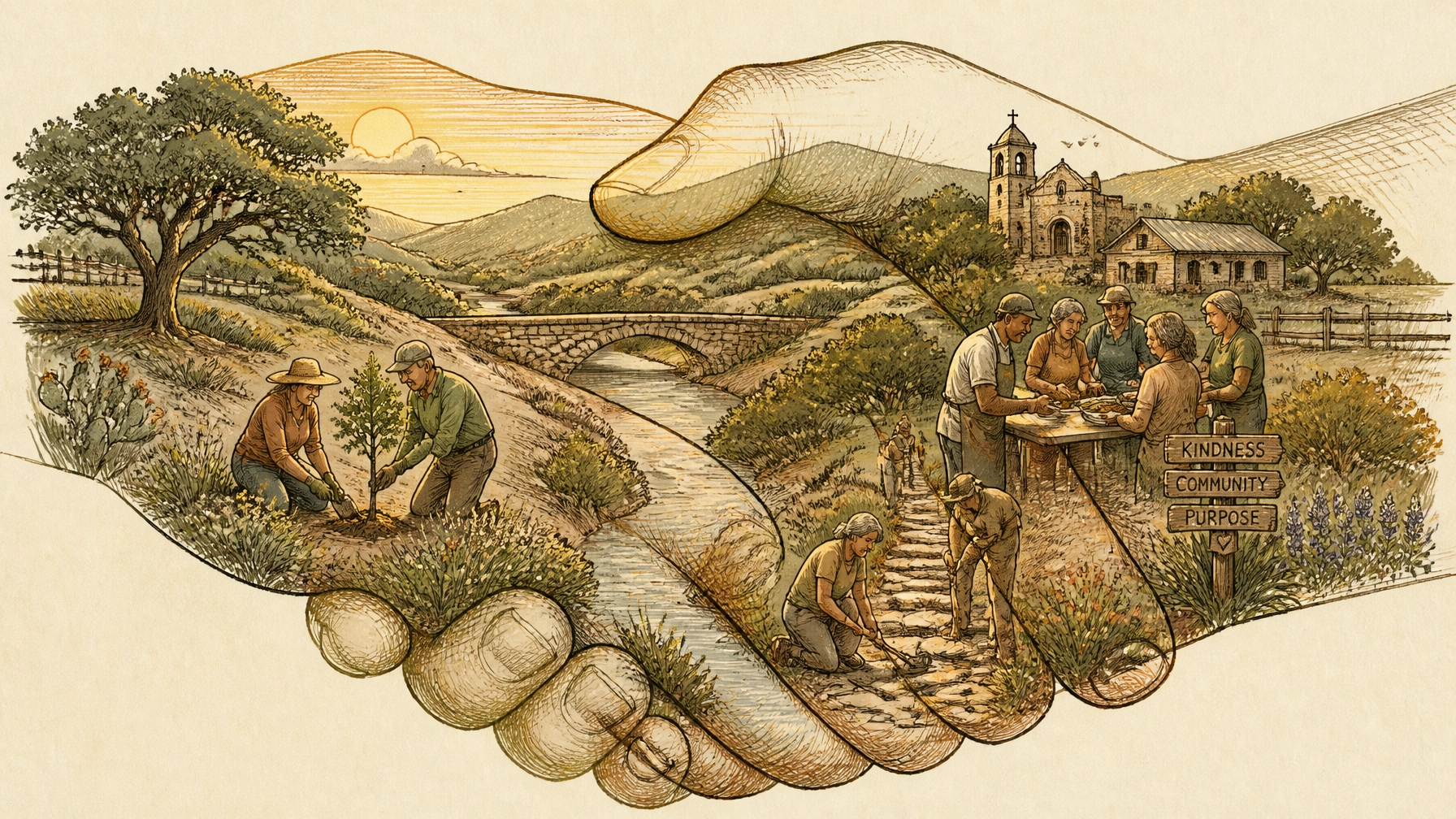
Retirement can bring more freedom, flexibility, and time for the experiences you postponed during your working years. But it can also quietly remove many of the social connections built into a career.
The informal conversations, familiar faces, shared projects, and regular invitations that came with work may become less frequent. A move to the Texas Hill Country can add another layer of change, especially if you are leaving longtime friends, neighbors, or family members behind.
That is where volunteering can make a meaningful difference.
In communities such as Boerne, Fredericksburg, and Wimberley, giving your time is more than a way to support a good cause. It is a practical way to meet people, establish a weekly rhythm, discover local history, and become part of the community you chose for retirement.
Why volunteering works so well after retirement
Friendships often grow through repeated, low-pressure contact. You see the same people, work toward a shared goal, and gradually move from introductions to familiar conversations.
Volunteering creates all three conditions.
A longitudinal study of more than 2,300 people approaching retirement found that social networks became smaller during the transition, particularly among less-close relationships that often include coworkers and other everyday contacts. The study also noted that retirement creates new opportunities to strengthen relationships with family, neighbors, friends, and volunteer groups. Read the study in the European Journal of Ageing.
This is important because your retirement social circle does not necessarily need to begin with deep friendships. It can begin with “weak ties”—the museum volunteer you see twice a month, the person beside you at a food-packing station, or the neighbor who joins the same trail workday.
Over time, those familiar faces can become coffee companions, walking partners, dinner guests, or trusted friends.
As Jimmy Doolittle, whose name is closely associated with the National Museum of the Pacific War in Fredericksburg, put it: “The heart of a volunteer is the strongest of all.”
Four Hill Country volunteer paths that encourage connection
The best volunteer opportunity is usually one that matches your interests and energy. It should also give you a reason to return regularly.
1. Museums and cultural organizations
Museums are especially appealing for retirees who enjoy history, art, storytelling, or meeting visitors from different places.
In Boerne, the Boerne Area Chamber of Commerce volunteer opportunities page lists community organizations seeking help, including cultural, educational, and nonprofit groups. Roles may include event assistance, visitor support, administrative work, or helping with local programs.
Fredericksburg offers several structured museum opportunities. The National Museum of the Pacific War Volunteer Corps welcomes volunteers for gallery attendance, visitor services, education programs, special events, administrative projects, and grounds work. The museum also provides formal training and an online application.
The Pioneer Museum relies on volunteers to support daily operations, events, and visitor experiences. For someone interested in the history of the German Hill Country, this can be a natural way to learn more about the community while meeting others who share that curiosity.
In Wimberley, the Wimberley Valley Museum offers docent opportunities. Volunteers receive training and generally serve a three-hour Saturday shift. The schedule is limited enough to feel manageable, while the recurring nature of the role creates opportunities to recognize and connect with fellow docents.
Museum volunteering can be especially rewarding if you are still learning your new town. Instead of simply reading about local history, you become part of the effort to preserve and share it.

2. Food assistance and direct community support
Food banks, pantries, and meal programs often provide some of the most social volunteer experiences because the work is hands-on and team-based.
In Boerne, Hill Country Daily Bread Ministries lists opportunities involving food sorting, packing, stocking, donation collection, event support, clothing assistance, and Friday evening distribution. Many assignments place volunteers side by side, making it easy to have natural conversations while doing useful work.
The Center for Community and Family Services offers several options, including Meals on Wheels driving, meal packing, kitchen help, food-box delivery, event assistance, and support at Kronkosky Place. Retirees who enjoy interacting with people may also consider helping with classes, dining services, or community programs.
In Fredericksburg, the Hill Country Community Needs Council coordinates services for local families, children, and older adults. You can contact the organization about volunteer opportunities connected to food assistance and other community-support programs.
Wimberley residents can explore the Wimberley Crisis Bread Basket volunteer program. Volunteers may help enroll clients, distribute food, stock shelves, receive donations, assist with food drives, or pick up donated food.
Food-related service often creates quick connections because every shift has a visible purpose. You are not simply attending an event; you are helping complete a specific task with a group of people who depend on one another.
3. Land conservation and outdoor stewardship
For retirees drawn to nature-focused living, conservation volunteering can connect social life with the landscape that attracted you to the Hill Country in the first place.
In Boerne, The Cibolo Center for Conservation offers individual and group opportunities, including short-term and ongoing roles. Volunteers can support the organization’s work in conservation, education, stewardship, and community connection.
In Wimberley, the city’s parks and recreation volunteer program includes Wednesday workgroups focused on trail repair, invasive-species removal, and park upkeep. These workgroups generally meet from October through May, offering a regular outdoor routine for people who enjoy being active.
Fredericksburg-area residents interested in protecting the broader Hill Country can learn more about the Hill Country Land Trust, a nonprofit focused on conserving agricultural land, wildlife habitat, scenic beauty, and watersheds. Volunteer needs may vary, so it is best to contact the organization directly about current opportunities.
Outdoor projects tend to encourage easy conversation. Walking between tasks, sharing tools, identifying native plants, or taking a break beneath the oaks can make introductions feel less formal than they might at a club or meeting.

4. Community nonprofits and local events
Not every volunteer role needs to be a long-term commitment. Community events can be a comfortable starting point if you are new to the area or uncertain about how much time you want to give.
Boerne’s volunteer listings include opportunities with animal organizations, theaters, youth programs, shelters, conservation groups, and seasonal events. The Boerne Community Theatre has listed front-of-house, backstage, construction, painting, concessions, lighting, and sound opportunities.
Fredericksburg’s Chamber volunteer page is another useful place to find current needs across local organizations.
In Wimberley, the parks department welcomes volunteers for community activities such as Concerts in the Park, Blue Hole Star Parties, holiday runs, and other special events. These one-day opportunities can help you sample different parts of community life before choosing a recurring role.
Event volunteering also offers a broader cross-section of local residents. You may meet longtime Hill Country families, other recent arrivals, seasonal residents, business owners, and retirees with interests beyond your immediate neighborhood.
How to turn volunteering into genuine friendships
Signing up is the first step, but connection usually comes from consistency.
Try these simple habits:
- Choose a recurring shift when possible rather than only attending one-time events.
- Arrive a few minutes early so you have time to talk before the work begins.
- Learn the names of staff members and other volunteers.
- Ask what brought someone to the organization or how long they have been involved.
- Accept invitations to volunteer lunches, appreciation events, or informal gatherings.
- After a few meetings, suggest coffee or lunch after a shift.
- Start with a manageable commitment—perhaps two or three hours every other week.
- Give yourself permission to try more than one organization before deciding what fits.
The goal is not to fill every hour of retirement. It is to create a dependable rhythm that brings you into contact with people who share your values.
A simple 90-day volunteering experiment
If you are preparing to retire or recently moved to the Hill Country, consider a 90-day experiment.
Choose one cultural organization, one community-support organization, and one outdoor or conservation opportunity. Attend each at least twice, then evaluate:
- Did the people seem welcoming?
- Did you enjoy the work itself?
- Could you imagine returning regularly?
- Did the schedule fit your energy and lifestyle?
- Did the role give you opportunities to interact with the same people?
You may discover that one organization becomes your primary social anchor. Or you may prefer a combination—a museum shift for history and conversation, a food program for direct service, and a trail workday for time outdoors.
Both approaches can support a fulfilling Texas Hill Country retirement lifestyle.
Volunteering is not a substitute for planning a sustainable retirement, but it can be an important part of designing a life that feels connected, purposeful, and enjoyable. As you compare communities such as Boerne, Fredericksburg, and Wimberley, look beyond homes, restaurants, wineries, and scenic views. Consider the organizations where you could contribute—and the people you might meet there.
Schedule a private meeting with a fiduciary financial advisor today by calling (512) 593-8380 or by visiting: https://calendly.com/portafoliocapital/15min
Portafolio Capital Management dba Mau Sanchez Capital is a Registered Investment Adviser. This content is for informational purposes only and does not constitute investment advice or a solicitation to buy or sell any security. Advisory services are provided only pursuant to a written advisory agreement.
This article may include stories, scenarios, and perspectives created or assisted by artificial intelligence. Although the individuals and circumstances described may be fictional, the topics are intended to reflect real financial, personal, and lifestyle issues that retirees and individuals commonly face. The content is provided to encourage readers to consider different perspectives that may affect their retirement, regardless of whether they are currently planning, approaching retirement, or already retired. It is intended for general educational and informational purposes only and should not be interpreted as personalized investment, financial, tax, legal, medical, or retirement-planning advice. Individual circumstances vary. Readers should independently verify any information presented and consult appropriately qualified professionals before making financial or personal decisions. No advisory, professional, or client relationship is created through the use of this website.
Leave a Reply