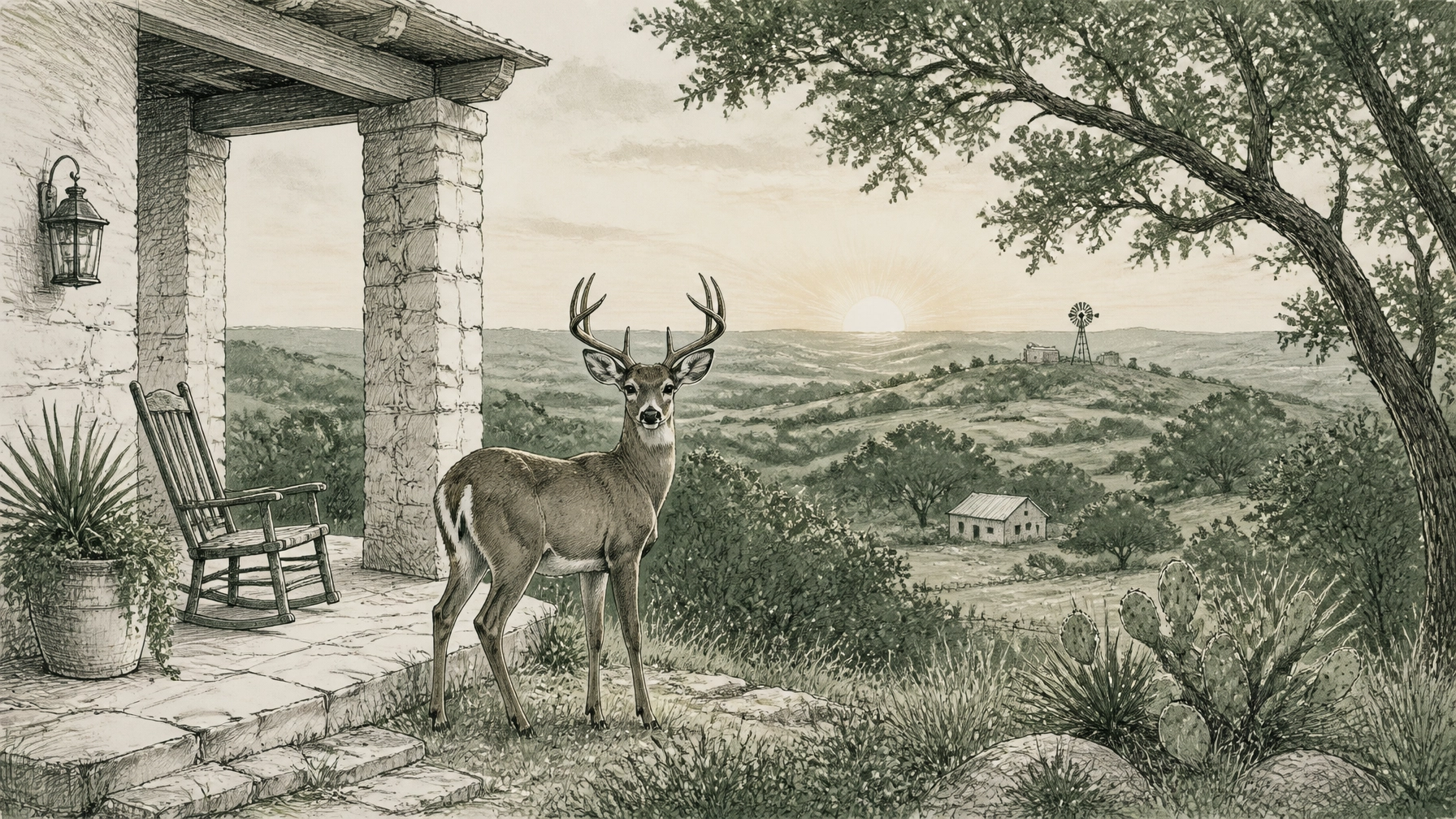
There is a specific kind of magic that happens during your first week living in the Texas Hill Country. You wake up, pour a cup of coffee, and step out onto your porch in Boerne or Wimberley, and there they are. A dozen white-tailed deer, frozen like statues in the morning mist, staring back at you with large, liquid eyes.
In that moment, you feel like you’ve finally arrived. You’ve traded the concrete jungle for a pastoral paradise. You feel a deep connection to nature. You might even reach for your phone to snap a photo to send to your friends back in Dallas or Houston.
Then, about three weeks later, you realize those "statues" have systematically decapitated every single one of your prize-winning hydrangeas.
Living in the Hill Country is a lesson in coexistence. It is a place where the line between "yard" and "wildlife preserve" is incredibly thin, if it exists at all. As someone who has helped many families navigate the transition from high-rise living to ranch life, I can tell you that the wildlife is one of the greatest joys of retiring here. But it also requires a strategy.
The "Deer Factory" of Texas
The Texas Hill Country is often referred to by biologists as the "Deer Factory of Texas." In some counties, the density is as high as one deer for every two to three acres. When you retire here, you aren't just moving into a new neighborhood; you are moving into their kitchen.
You will encounter two primary types: the native White-tailed deer and the exotic Axis deer.
White-tailed deer are the locals. They are graceful, ubiquitous, and bold. They have learned that suburban gardens are essentially high-end salad bars. Axis deer, originally from India, are larger, sturdier, and often travel in bigger herds. They are striking to look at with their permanent white spots, but they are also formidable competitors for resources.
The reality of living with deer is that "deer-resistant" is a relative term. In a dry Texas summer, a hungry deer will eat almost anything that isn't made of stone. I’ve seen them nibble on thorny cacti when they’re desperate. If you want a lush garden, you have to play defense.
Pro-Tip for the Hill Country Gardener:
If you are planning your outdoor living space, an eight-foot fence is the gold standard for exclusion. If a tall fence doesn't fit your aesthetic, focus on plants with strong scents and fuzzy textures. Rosemary, Lavender, and Texas Mountain Laurel are generally safe bets, as the oils and textures are unappealing to the "neighbors."

The Afternoon Parade: Wild Turkeys and Armadillos
While the deer handle the landscaping, the Wild Turkeys handle the entertainment. It is not uncommon to see a flock of twenty turkeys strutting across your driveway with an air of immense self-importance.
Turkeys are relatively harmless, though they are world-class excavators of mulch. If you’ve spent the weekend perfectly grooming your flower beds, don't be surprised if a tom turkey decides that’s the perfect place to scratch for insects. They are a delight to watch, especially during the spring mating season when the males are in full display, but they do require a "live and let live" attitude toward your yard's perfection.
Then there is the Armadillo, the state small mammal of Texas and the bane of many a manicured lawn.
Armadillos are the "cleaning crew." They are largely nocturnal and spend their nights snuffling through the soil for grubs and beetles. The problem is their method: they dig small, cone-shaped holes everywhere they go. If you wake up and your lawn looks like it was the site of a very tiny, very disorganized construction project, you’ve had an armadillo visit.

The Ones Who Demand Respect: Snakes and Safety
We cannot talk about Hill Country wildlife without mentioning the residents that demand the most space: snakes.
The Hill Country is home to over a hundred species of snakes, and the vast majority are non-venomous and highly beneficial. They keep the rodent population in check, which is vital when you live near open acreage. However, we do have the "big four" venomous varieties: Western Diamondback Rattlesnakes, Copperheads, Cottonmouths (near water), and the elusive Texas Coral Snake.
Most retirees find that snake encounters are rare and usually involve the snake trying to get away from you as fast as possible. According to Texas Parks and Wildlife, snakes are generally shy. The key is "Risk Management."
- Keep it Tidy: Don't keep woodpiles or tall grass right against your house.
- Watch Your Step: Wear closed-toe shoes when walking through brush, especially at dusk.
- Give Space: If you see one, stop, back away slowly, and let it go about its business.
Living with snakes is less about fear and more about awareness, much like navigating a volatile market.
Coexistence as a Lifestyle Choice
Retiring in the Hill Country is about embracing a slower, more intentional pace of life. It’s about active lifestyle hubs and community events, but it’s also about the quiet moments on the porch.
When you stop fighting the wildlife and start planning for it, the stress melts away. You learn that a few holes in the yard from an armadillo are a fair price to pay for the sight of a Painted Bunting at your birdfeeder or the sound of coyotes howling in the distance under a canopy of stars.

The Parallel: Wildlife and Wealth Management
Interestingly, the lessons we learn from the Hill Country wildlife often mirror the lessons we apply to retirement planning.
Just as a gardener must protect their prize roses from the unexpected arrival of a hungry deer herd, an investor must protect their retirement income from the "wildlife" of the financial markets, volatility, inflation, and unexpected shifts in the economic landscape.
At Mau Sanchez Capital, our investment philosophy is built on the same principles of coexistence and preparation. We don't try to "control" the market any more than you can control the path of a wild turkey. Instead, we focus on:
- Proper Asset Allocation: Ensuring your portfolio is sturdy enough to weather different seasons.
- Liquidity and Transparency: Utilizing publicly traded markets so you always know where you stand and can access your funds when needed.
- Risk Management: Constructing portfolios designed to mitigate the "predators" of your wealth, such as excessive fees and unnecessary complexity.
Just as you might install a fence to protect your garden while still enjoying the view of the hills, we help you build a financial structure that protects your lifestyle while allowing you to participate in the growth of the global economy.

Conclusion: Is the Tradeoff Worth It?
Every morning, when I see the deer grazing in the distance or hear the call of a hawk circling overhead, I am reminded why people flock to this region. The wildlife isn't a nuisance; it's the heartbeat of the Hill Country. It reminds us that we are part of something larger and more enduring than the daily news cycle.
Yes, they might eat your garden. Yes, you might have to check your boots for a stray scorpion once in a while. But the peace, the beauty, and the profound sense of place you find here are worth every bit of the effort.
If you are ready to make the move and want to ensure your financial "garden" is well-protected for the years ahead, let’s start a conversation.
Schedule a private meeting with a fiduciary financial advisor today by calling (512) 593-8380 or by visiting: https://calendly.com/portafoliocapital/15min
Portafolio Capital Management dba Mau Sanchez Capital is a Registered Investment Adviser. This content is for informational purposes only and does not constitute investment advice or a solicitation to buy or sell any security. Advisory services are provided only pursuant to a written advisory agreement.
This article may include stories, scenarios, and perspectives created or assisted by artificial intelligence. Although the individuals and circumstances described may be fictional, the topics are intended to reflect real financial, personal, and lifestyle issues that retirees and individuals commonly face. The content is provided to encourage readers to consider different perspectives that may affect their retirement, regardless of whether they are currently planning, approaching retirement, or already retired. It is intended for general educational and informational purposes only and should not be interpreted as personalized investment, financial, tax, legal, medical, or retirement-planning advice. Individual circumstances vary. Readers should independently verify any information presented and consult appropriately qualified professionals before making financial or personal decisions. No advisory, professional, or client relationship is created through the use of this website.
Leave a Reply