
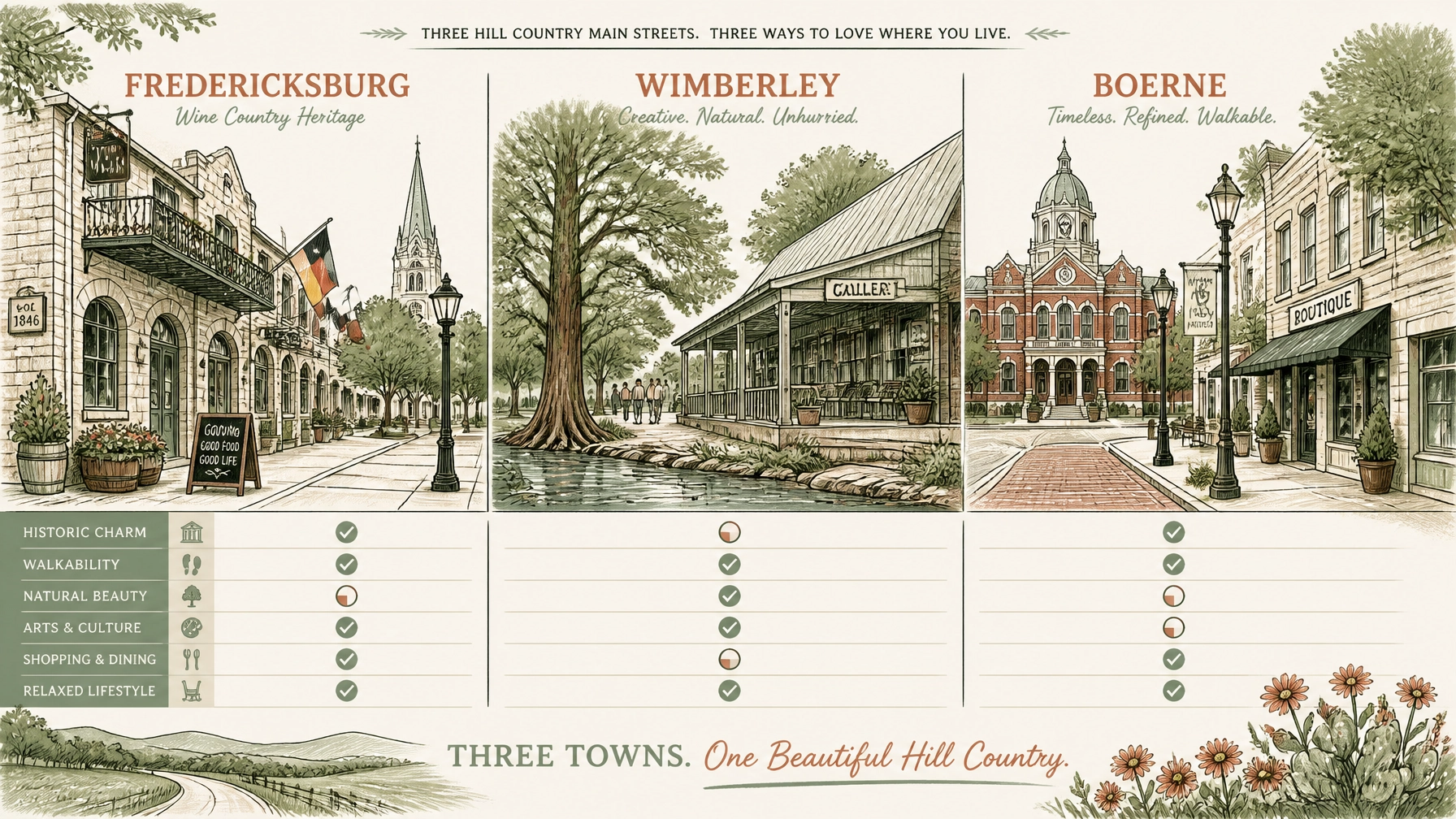
I have looked at enough Hill Country real estate listings to know that a beautiful photograph can hide an inconvenient truth.
The home may have a limestone exterior, a sweeping view, and a generous back porch. But what happens when the nearest specialist is an hour away? Or when weekend traffic turns your quiet wine-country road into a procession of visitors? Or when property taxes, insurance, maintenance, and utilities make the house far more expensive to own than the listing price suggests?
That is why I would not rank Boerne, Wimberley, Fredericksburg, Dripping Springs, and New Braunfels by home prices alone.
For this comparison, I am treating a $1 million budget as the total pool available for housing, relocation costs, and the lifestyle that follows, not as a $1 million house budget. The question is not simply, “What can I buy?” It is:
Which town gives me the best combination of home, convenience, experiences, and financial breathing room?
My Retirement Relocation Scorecard
I scored each community across five categories:
- Housing flexibility: How much choice the budget provides
- Daily convenience: Groceries, services, medical access, and transportation
- Lifestyle value: Dining, arts, wine, music, trails, and outdoor recreation
- Peace and privacy: How easy it is to enjoy a slower pace
- Budget resilience: How much room remains after buying and carrying the home
This is not a formal real estate ranking or a promise about future prices. It is a practical framework for affluent pre-retirees who want to compare the entire retirement experience.
| Community | Housing flexibility | Convenience | Lifestyle value | Peace and privacy | $1M budget flexibility | Best fit |
|---|---|---|---|---|---|---|
| Boerne | 3.5/5 | 4.5/5 | 4/5 | 3.5/5 | 3.5/5 | Refined small-town living near San Antonio |
| Wimberley | 3.5/5 | 2.5/5 | 4.5/5 | 4.5/5 | 3.5/5 | Nature, arts, and a genuinely slower pace |
| Fredericksburg | 3/5 | 4/5 | 5/5 | 2.5/5 | 3/5 | Wine, culture, restaurants, and frequent visitors |
| Dripping Springs | 3.5/5 | 3.5/5 | 4.5/5 | 3/5 | 3.5/5 | Hill Country scenery with Austin access |
| New Braunfels | 4/5 | 4.5/5 | 4.5/5 | 3/5 | 4/5 | River life, entertainment, and broader services |
The scores are only useful if we explain what they mean in real life.
Boerne: The Most Balanced Premium Choice
Boerne is the town I would put near the top of the list for someone who wants Hill Country character without giving up access to major-city services.
The historic downtown, known as the Hill Country Mile, offers boutiques, galleries, restaurants, and an easy sense of place. Outdoor options such as the Cibolo Nature Center add walking trails and nature experiences without requiring a full-day expedition.
The financial trade-off is that Boerne’s popularity is already reflected in its housing market. A $1 million total retirement budget can buy a very comfortable home, but the budget becomes less flexible if you insist on acreage, extensive upgrades, a premium view, or a highly amenitized community.
Boerne’s real value is not necessarily getting the most square footage. It is buying a lifestyle that keeps San Antonio’s medical centers, shopping, dining, and airport within practical reach.
I would rank Boerne highly for someone who wants a polished, established community and expects to use city services regularly. I would be more cautious if the dream is complete seclusion on several acres.
For more context on the town’s backroads, downtown character, and proximity to San Antonio, see our guide to why some retirees are choosing Boerne over Austin.

Wimberley: The Best Lifestyle if You Value Quiet More Than Convenience
Wimberley is not the choice I would make for someone who wants every service five minutes away. It may be the choice I would make for someone who values privacy, natural beauty, and a slower daily rhythm above almost everything else.
The town’s identity is tied to Cypress Creek, the Blanco River, Blue Hole Regional Park, Jacob’s Well, local artists, and the small businesses around the square. The scenery is not an accessory here. It is the lifestyle.
With $1 million, Wimberley may allow you to pursue a more private home, a larger lot, or a retreat-like setting. But that same rural appeal introduces costs that do not always appear in a listing:
- Longer drives for specialty healthcare
- More dependence on a vehicle
- Potentially higher maintenance for acreage
- Well, septic, driveway, and land-management responsibilities
- Fewer housing choices when inventory is limited
Wimberley can offer tremendous lifestyle value, but only if you are comfortable trading convenience for soul. A scenic property is not a bargain if you spend your retirement commuting to every appointment, shopping trip, and cultural activity.
Fredericksburg: The Strongest Culture, the Weakest Quiet-Time Score
Fredericksburg is the easiest town on this list to fall in love with during a weekend visit.
There is the German heritage, the historic architecture, the restaurants, the museums, the galleries, and the wine corridor. Nearby Enchanted Rock adds a powerful outdoor dimension, while the surrounding vineyards make it easy to create a social calendar around tastings, dinners, and visiting friends.
But living in a destination is different from vacationing in one.
Fredericksburg’s tourism economy can bring crowded weekends, event traffic, noise, and elevated demand for desirable properties. A house near Main Street may place you close to everything you enjoy — but also close to the people who came to enjoy it for two days.
A $1 million budget may work well for a comfortable in-town home or a quieter property farther out. It becomes more challenging when the goal is a large, luxury home in a prime wine-country location while also preserving substantial reserves for travel and long-term living expenses.
I would recommend Fredericksburg to the retiree who wants culture to come to the front door. If your ideal retirement includes spontaneous dinners, tasting rooms, concerts, and a steady stream of guests, its premium may be worthwhile.
If your ideal evening is total silence, visit on a busy Saturday before making a decision.

Dripping Springs: The Austin Connection Comes with a Growth Trade-Off
Dripping Springs offers an appealing middle ground — Hill Country scenery, wineries, breweries, distilleries, outdoor recreation, and relatively easy access to Austin.
That combination explains much of its appeal to affluent pre-retirees who are not ready to disconnect from the city. You can spend the morning on a trail, meet friends for lunch, and still attend a concert or cultural event in Austin.
The trade-off is growth. Dripping Springs is no longer a sleepy outpost. Roads, development patterns, construction, and traffic — especially along Highway 290 — are part of the daily calculation.
A $1 million budget can provide a comfortable home and a strong lifestyle here, especially if you do not overcommit to a large, highly customized property. But I would look carefully at commute patterns, future development nearby, internet reliability, and the practical distance to healthcare.
Dripping Springs is a good fit for the person who wants a nature-focused retirement but still expects Austin-level access to restaurants, entertainment, and services.
New Braunfels: The Best Room for Lifestyle Spending
New Braunfels is the most city-like community in this comparison. It offers the Comal and Guadalupe Rivers, Gruene’s historic charm, live music, festivals, restaurants, shopping, and a broader collection of everyday services.
That scale can make a meaningful difference in retirement. You are more likely to find multiple grocery options, healthcare providers, contractors, restaurants, and social activities without driving across the region.
The lifestyle is active and water-oriented, but it is not always quiet. Summer tubing season, tourism, traffic, and growth are part of the package. Some neighborhoods feel distinctly suburban rather than rural, while others provide easier access to the river, historic districts, or open Hill Country scenery.
From a $1 million perspective, New Braunfels often offers the greatest flexibility. You may be able to buy a comfortable home without consuming as much of the total budget, leaving more room for travel, dining, hobbies, healthcare, and portfolio reserves.
I would rank it highest for someone who wants options. If you want a river lifestyle, more services, and a full calendar of activities, New Braunfels deserves serious attention.

The Hidden Costs That Can Change the Ranking
The purchase price is only the beginning. Before choosing a town, I would estimate the full annual cost of the lifestyle.
Property taxes
Texas does not levy a state personal income tax, but local property taxes remain an important part of homeownership. As the Texas Comptroller explains, local taxing units — not the state — set and collect property taxes.
“Texas has no state property tax.” — Texas Comptroller of Public Accounts
That does not mean property taxes are irrelevant. Use the state’s Property Tax Transparency portal to investigate the specific county, appraisal district, and taxing units attached to a property.
Insurance
Insurance can vary dramatically based on the home’s age, construction, roof, trees, acreage, and proximity to waterways or brush. A rural property may also require additional attention to outbuildings, gates, wells, septic systems, and long driveways.
Before making an offer, obtain an actual insurance quote. Do not rely on an estimate from a listing description.
Utilities and maintenance
A newer home in a master-planned community may have predictable maintenance but recurring HOA costs. An older ranch property may offer more land and privacy but require ongoing work.
Ask about:
- HVAC age and expected replacement
- Roof and foundation condition
- Water source and storage
- Septic inspection and pumping history
- Well equipment
- Road and driveway maintenance
- Landscaping and tree care
- Backup power needs
Healthcare and transportation
A town can feel close to a medical center on a map and much farther away during traffic, bad weather, or a health emergency. Consider both routine care and specialized care.
The Texas Department of State Health Services and local healthcare systems can help you identify regional resources, but the most useful test is personal — drive the route from the home you are considering to the doctors and hospitals you expect to use.

My Final Ranking
If I had to summarize the scorecard:
- Boerne is the strongest all-around choice for convenience, polish, and proximity to San Antonio.
- Wimberley offers the most peace and natural character, provided you accept fewer nearby services.
- Fredericksburg delivers the richest wine and cultural experience, with more tourism than some retirees expect.
- Dripping Springs is ideal for Austin access, outdoor recreation, and craft beverage culture, but growth is impossible to ignore.
- New Braunfels offers the most everyday flexibility and room for lifestyle spending, especially for active, water-oriented retirees.
The best town is not necessarily the one where $1 million buys the largest house. It is the one where your home, daily rhythm, social life, healthcare needs, and long-term financial plan fit together without constant compromise.
If you are comparing a home purchase with a portfolio designed to fund several decades of retirement, learn more about Mau Sanchez Capital or consider discussing your goals with a fiduciary advisor before committing to a property.
Schedule a private meeting with a fiduciary financial advisor today by calling (512) 593-8380 or by visiting: https://calendly.com/portafoliocapital/15min
Portafolio Capital Management dba Mau Sanchez Capital is a Registered Investment Adviser. This content is for informational purposes only and does not constitute investment advice or a solicitation to buy or sell any security. Advisory services are provided only pursuant to a written advisory agreement.
This article may include stories, scenarios, and perspectives created or assisted by artificial intelligence. Although the individuals and circumstances described may be fictional, the topics are intended to reflect real financial, personal, and lifestyle issues that retirees and individuals commonly face. The content is provided to encourage readers to consider different perspectives that may affect their retirement, regardless of whether they are currently planning, approaching retirement, or already retired. It is intended for general educational and informational purposes only and should not be interpreted as personalized investment, financial, tax, legal, medical, or retirement-planning advice. Individual circumstances vary. Readers should independently verify any information presented and consult appropriately qualified professionals before making financial or personal decisions. No advisory, professional, or client relationship is created through the use of this website.
Leave a Reply